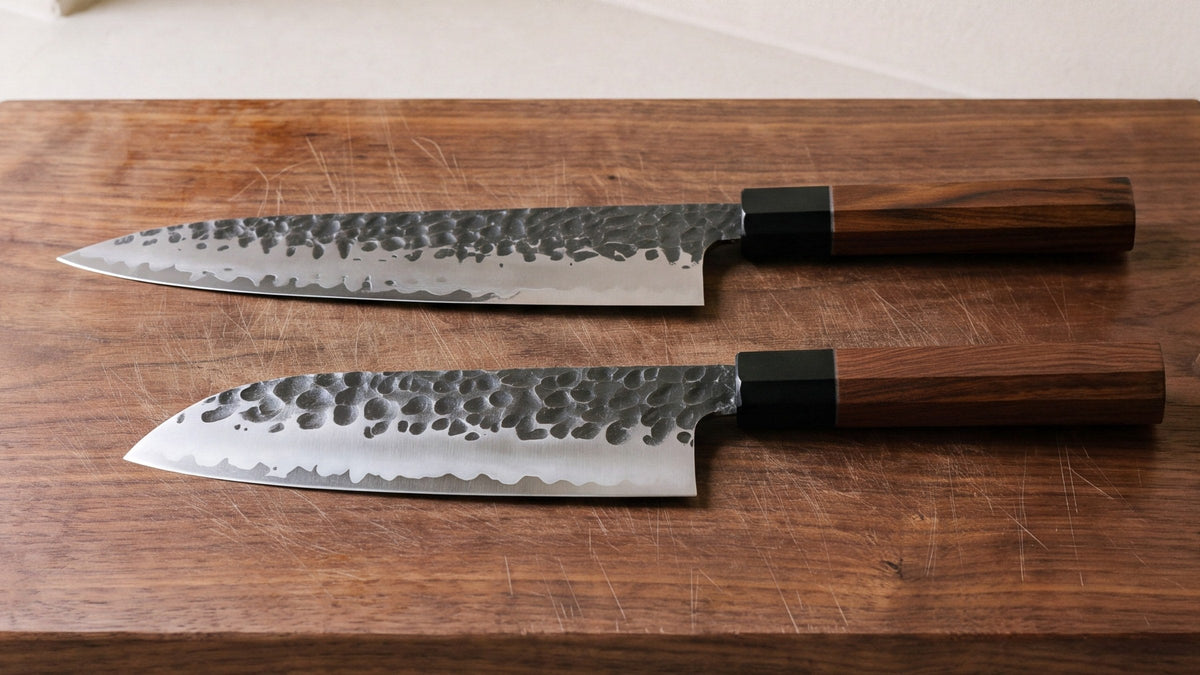
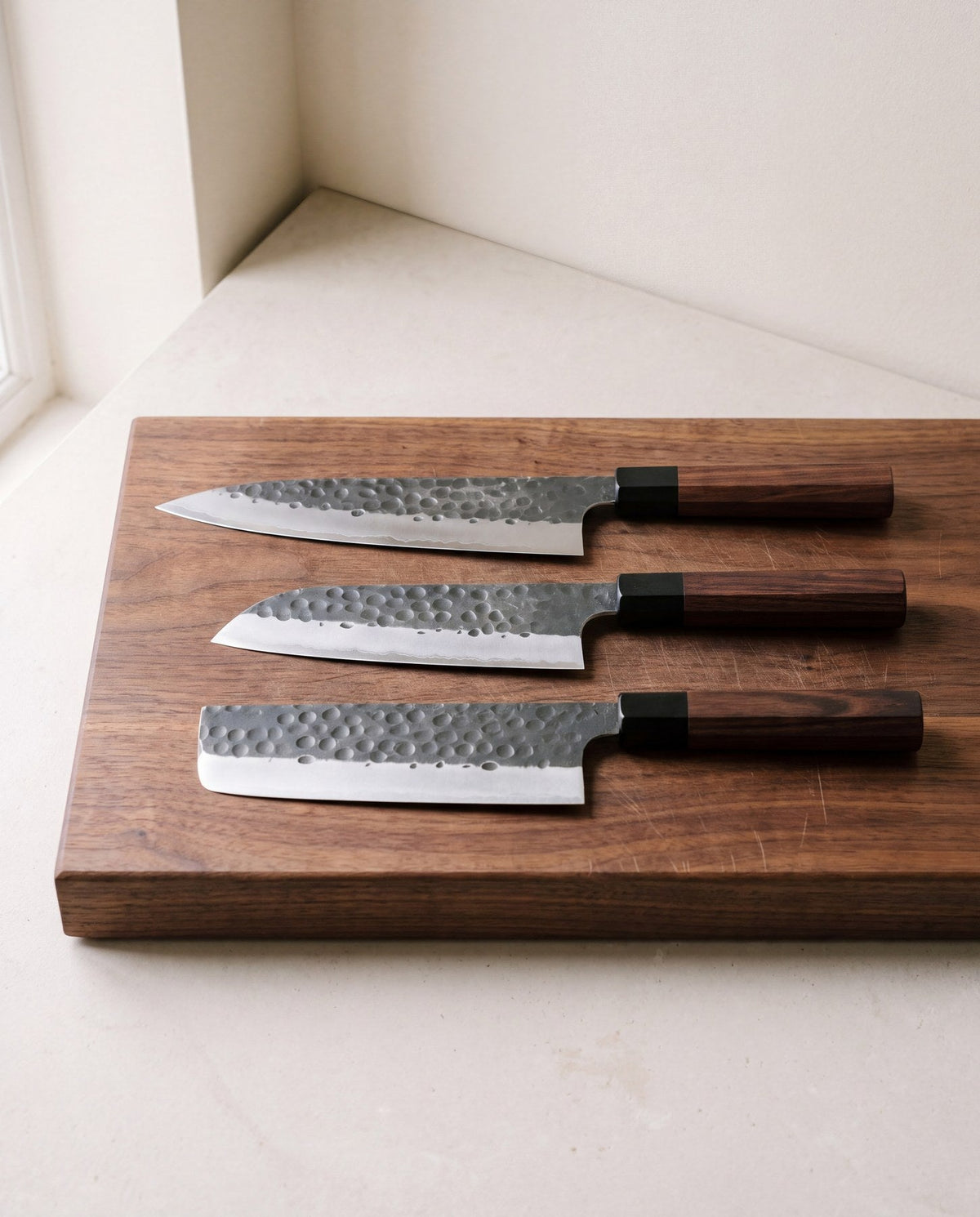
Blade length decides how a knife feels in your hand, how much cutting board it needs and how many strokes a job takes. Most home cooks start with an 8 inch (20 cm) Gyuto or a 7 inch (18 cm) Santoku. This guide shows the lengths we offer for each shape, how to decide between them and what to buy first.
Short answer: For one main knife, an 8 inch (20 cm) Gyuto suits most home cooks. Choose a 7 inch (18 cm) Santoku if you want a shorter all-rounder for a small board or smaller hands. Add a 5 inch (13 cm) Petty for small jobs, and a Nakiri if most of your prep is vegetables.
Knife Sizes at a Glance
Lengths are the edge, measured from heel to tip, without the handle.
| Shape | Lengths | Most common | Best for |
|---|---|---|---|
| Gyuto | 6-9 in 15-23 cm |
8 in 20 cm |
All-round prep, meat, big produce |
| Santoku | 5-7.5 in 13-19 cm |
7 in 18 cm |
Everyday chopping |
| Nakiri | 5.5-7.5 in 14-19 cm |
7 in 18 cm |
Vegetables |
| Kiritsuke | 6.5-9 in 16.5-23 cm |
8 in 20 cm |
Long slices, fine tip work |
| Petty | 4.5-5.5 in 11.5-14 cm |
5 in 13 cm |
Trimming, small fruit, shallots |
| Paring | 3-4 in 7.5-10 cm |
3.5 in 9 cm |
Peeling in the hand |
Why 8 Inches (20 cm) Suits Most Home Cooks
An 8 inch (20 cm) Gyuto is long enough to slice a roast, halve a cabbage or rock through a pile of herbs in full strokes, and short enough to stay easy to control on a normal home board. That balance is why most of the Gyuto knives we sell are this length. At 8 inches (20 cm) a HARUTANI Gyuto weighs about 7 oz (200 g), light enough for a long prep session.
A shorter blade is the better pick when your kitchen, your hands or your cooking point that way. The four checks below tell you which.
How to Decide: Four Checks
1. Your hand
Fit comes more from the handle and balance than from blade length. Look for a handle that fills your grip comfortably, enough blade height to keep your knuckles off the board and a balance point close to where you pinch the blade. As general guidance, larger hands usually find an 8 inch (20 cm) Gyuto in proportion, while smaller hands, or cooks new to a very sharp knife, often find a 7 inch (18 cm) Santoku (about 6 oz, 170 g) easier to steer.
2. What you cook
- Large cuts and big produce: roasts, carving a cooked chicken, squash, cabbage and melons go faster with an 8 inch (20 cm) Gyuto or Kiritsuke.
- Mostly vegetables: onions, carrots, peppers and greens for weeknight meals suit a 7 inch (18 cm) Santoku or Nakiri.
- Small jobs: trimming, hulling strawberries and slicing shallots or garlic suit a 5 inch (13 cm) Petty (about 3.5 oz, 100 g).
Whatever the length, do not cut through bones or frozen food with these knives.
3. Your cutting board
A longer blade needs room for a full stroke. As a rule of thumb, pick a board at least twice as long as the blade: about 16 inches (40 cm) for an 8 inch (20 cm) knife, about 14 inches (36 cm) for a 7 inch (18 cm) one. If your board is smaller and you do not plan to change it, the shorter knife will feel better every day.
4. Your storage
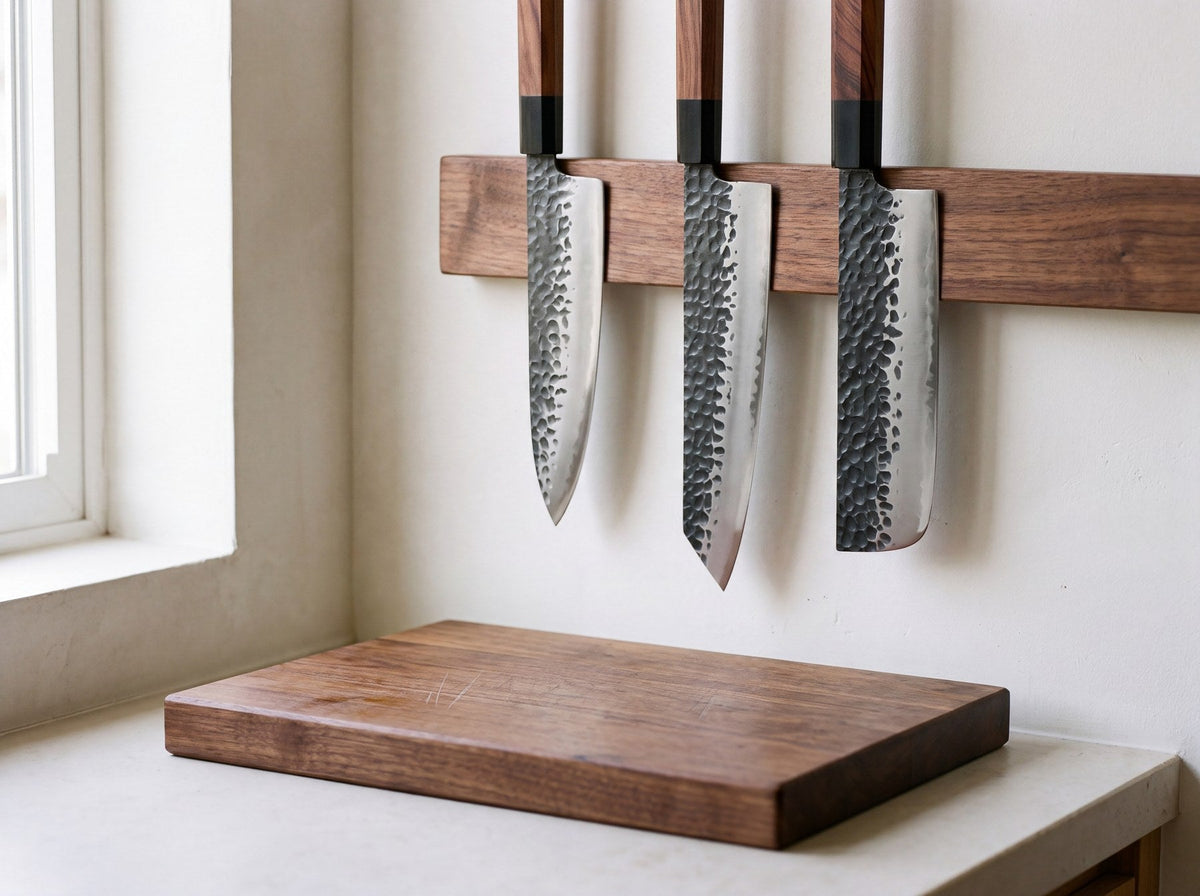
Measure before you buy a long blade. A knife block slot, an in-drawer tray or a magnetic strip must take the whole blade, and a 9 inch (23 cm) Gyuto needs a deeper slot than a Petty. Our guide on how to store Japanese chef knives compares each option.
The Hold Test
You cannot hold a knife through a screen, but the knife already in your kitchen can stand in for it.
- Measure your current chef knife from heel to tip.
- Cook one meal and notice what it does. Does it feel right, too short or too long?
- Adjust by about an inch (2.5 cm). If you saw back and forth through wide food, go longer. If the tip runs off the board or feels hard to guide, go shorter.
Tip: Do the test with a pinch grip: thumb and index finger on the blade just in front of the handle. Most cooks hold a Japanese chef knife this way, and it makes any length feel steadier.
When to Go Longer or Shorter
Eight inches (20 cm) is the middle of the range, not a rule. Our Gyuto and Kiritsuke knives go up to 9 inches (23 cm), and our shortest Gyuto is 6 inches (15 cm). A 7 inch (18 cm) Santoku or Nakiri is the other compact option.
Go longer if
- You often cook for a crowd or break down large cuts.
- You have a large board and plenty of counter space.
- You are already at ease with an 8 inch (20 cm) knife.
Go shorter if
- Your board, counter or drawer is on the small side.
- You have smaller hands or want more control.
- Most of what you cut is vegetables for one or two people.
What to Start With
- One knife: an 8 inch (20 cm) Gyuto, or a 7 inch (18 cm) Santoku if you prefer a straight chop and a shorter blade. Not sure which shape? Read Gyuto vs Santoku.
- Two knives: add a 5 inch (13 cm) Petty for the small jobs a long blade handles awkwardly.
- Lots of vegetables: a 7 inch (18 cm) Nakiri next to your Gyuto.
- A flatter edge with an angled tip: an 8 inch (20 cm) Kiritsuke.
Every HARUTANI knife has the same VG-10 steel core inside 67 layers of Damascus cladding, hardened to 60 ±2 HRC, with a 12 to 15 degree edge on each side. So the choice is about length and shape, not quality. Many of our knife sets pair a Gyuto with a Petty, or a Gyuto, Nakiri and Petty, so you can cover everyday prep and smaller jobs in one matching style.