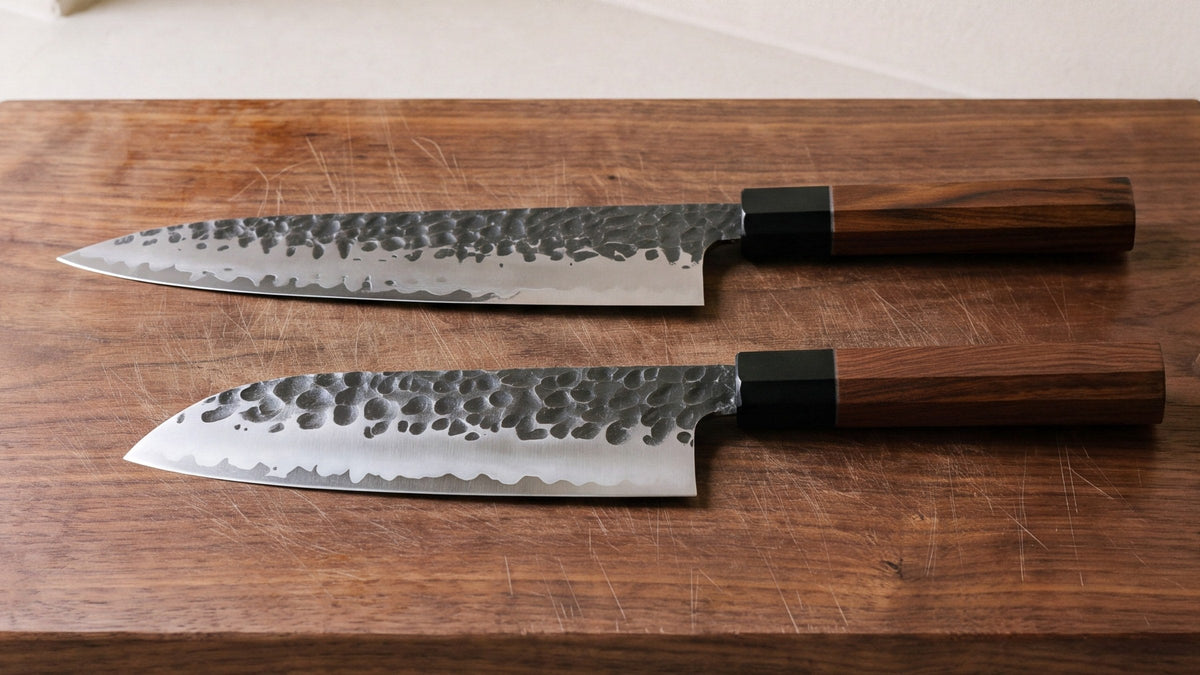
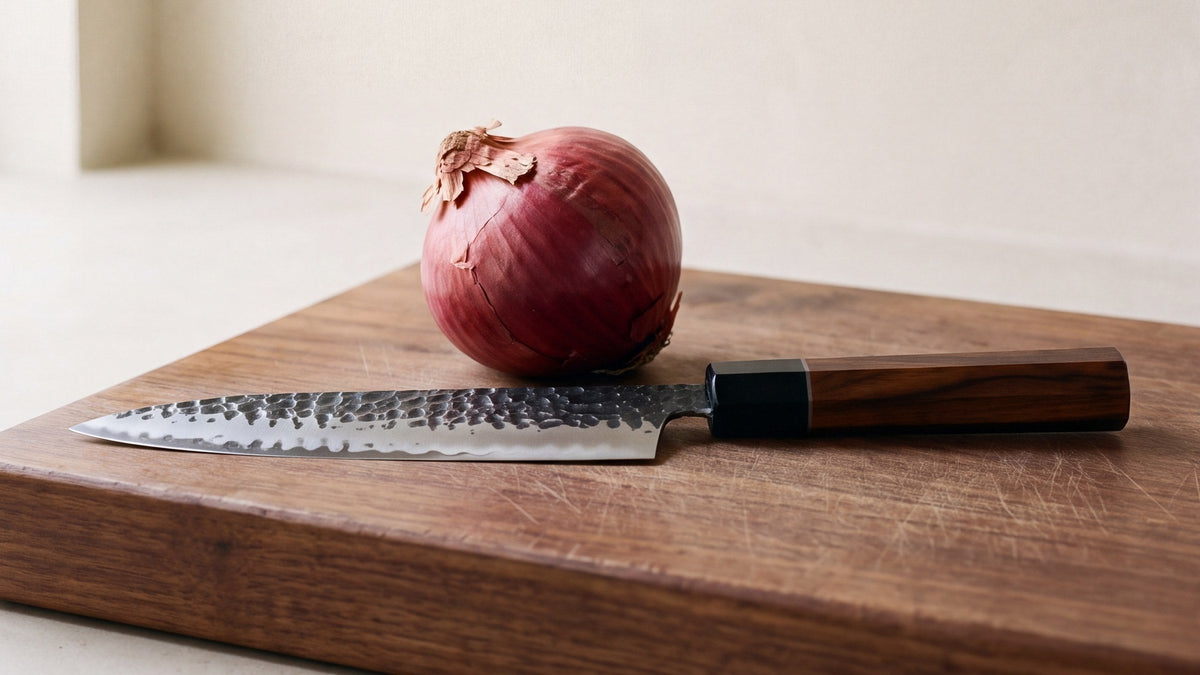
Choosing a Japanese chef knife comes down to three questions: which blade shape suits the way you cut, what length feels right in your hand and on your board, and which handle you prefer. Steel matters too, but once you know what to look for it is the easiest part of the decision.
The short answer: most home cooks start with an 8 inch Gyuto or a 7 inch Santoku. Pick the Gyuto if you rock the knife and want one long blade for everything, or the Santoku if you chop straight down and want a compact blade. Add a Nakiri for vegetables, a Kiritsuke for a longer, flatter chef blade, or a Petty knife for small, detailed work.
The Five Shapes at a Glance
| Shape | Length | Best for | Pick it if |
|---|---|---|---|
| Gyuto | 8 in | Meat, fish, big vegetables | You want one knife for most jobs |
| Santoku | 7 in | Vegetables, fast chopping | You chop straight down |
| Nakiri | 7 in | Vegetables and greens | Most of your prep is produce |
| Kiritsuke | 8 in | Long slices, fine tip work | You want a longer, flatter blade |
| Petty | 5 in | Trimming, peeling, fruit | You need a small second knife |
The lengths above are the most common in our range. Each shape also comes shorter or longer; the full ranges are listed at the end of this guide.
Start With How You Cut
Before comparing specs, think about the motion you already use. If you learned on a Western chef knife, you probably rock the blade: the tip stays near the board while the heel lifts and falls. A curved edge, like a Gyuto's, suits that motion. If you lift the whole knife and chop straight down, a flatter edge, like a Santoku's or a Nakiri's, meets the board along more of its length and feels more natural.
Then think about what you cut most. Large cuts of meat, whole fish and big vegetables reward a longer blade. Quick weeknight prep of onions, carrots and herbs is easy with a shorter one. For a side-by-side look at the two most popular shapes, read Gyuto vs Santoku.
The Five Shapes Explained
Gyuto: the all-rounder
The Gyuto is the Japanese-style version of the Western chef knife: a long, gently curved edge that rises to a fine point. It rocks through herbs and garlic, slices a roast or a fish fillet in one long stroke, and the tip handles trimming. If you want one knife to do almost everything, this is it.
Santoku: compact and easy to control
The Santoku is shorter, with a flatter edge and a spine that curves down to meet it at the tip. It suits a straight up-and-down chop and a forward push cut, and its shorter length feels controlled on a small board or in smaller hands. It handles meat, fish and vegetables, which makes it a strong first knife too.
Nakiri: made for vegetables
The Nakiri has a straight, flat edge and a square tip. The whole edge meets the board at once, so it cuts cleanly through onions, cabbage and carrots without the rocking that can leave slices joined at the bottom. It is a specialist: excellent for produce, not for meat or fish with bones.
Kiritsuke: a longer, flatter chef blade
The Kiritsuke pairs a Gyuto's length with a flatter edge and an angled tip. It works best with long push and pull strokes rather than rocking, and the angled tip is precise for fine work such as scoring or slicing thin. Choose it if you like a long blade but prefer to slice rather than rock.
Petty and paring: small, detailed work
A Petty is a small utility knife for the jobs a chef knife is too big for: trimming meat, slicing shallots, peeling and cutting fruit. A paring knife is shorter still and made for work held in the hand. Most kitchens use one alongside a Gyuto or Santoku rather than instead of one.
What Size to Choose
An 8 inch Gyuto is the standard length for a home chef knife: long enough for big jobs, short enough to control. If your board is small, your counter is tight or you have smaller hands, a 7 inch Santoku or a 7 inch Gyuto often feels more natural. A longer blade covers more of the board in each stroke but needs a board with room for the full stroke.
Weight follows length. As a rough guide, our 8 inch Gyuto knives weigh about 7 oz and our 7 inch Santoku knives about 6 oz. For more on matching length to your hand, board and storage, read How to Choose the Right Knife Size.
Steel, Hardness and Edge
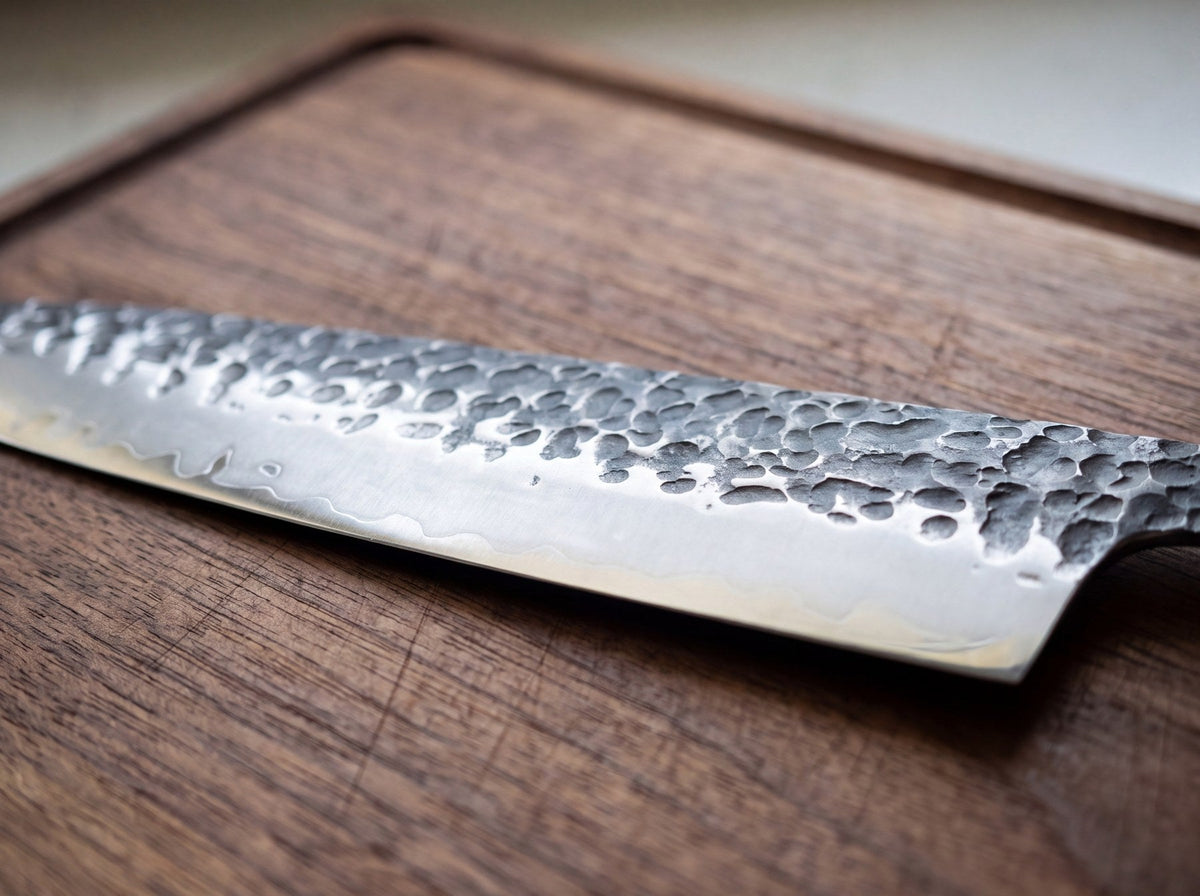
The steel decides how sharp a knife gets and how long it stays that way. Every HARUTANI knife uses the same construction: a VG-10 steel core inside 67 layers of Damascus cladding, hardened to 60 ±2 HRC, with a hand-finished 12 to 15 degree edge on each side. Because the steel is the same across the range, your choice is about shape, length and handle, not quality.
What that means in the kitchen:
- A hard core holds its edge. VG-10 at 60 ±2 HRC stays sharp longer than softer stainless steel, so you sharpen less often.
- A thin edge cuts cleanly but should be sharpened on a whetstone, not with a pull-through sharpener, and refreshed with a fine ceramic rod or a leather strop rather than a ridged honing steel.
- Stainless still needs drying. VG-10 resists rust well, but wash the knife by hand and dry it straight away.
- Use a wood or plastic board. Glass, stone and ceramic dull or chip a hard edge. Leave bones and frozen food to a heavier tool.
Japanese or Western Handle
Most HARUTANI knives have a Japanese-style octagonal wa handle, and some have a Western grip. A wa handle is light, so the balance sits forward toward the blade, and its eight flat sides give a secure hold in a pinch grip. A Western grip is fuller in the hand and feels familiar if you are used to a European chef knife. Neither is better; choose the one that feels right. Materials include rosewood, ebony, olivewood, stabilized burl with resin and G10.
One Knife or a Set?
If you are buying your first Japanese knife, start with one Gyuto or Santoku and use it for a few weeks. You will soon notice which jobs you want a second blade for. The usual second knife is a Petty for small work, then a Nakiri if you cook a lot of vegetables.
If you already know you want more than one, a set is the simpler route: every knife in it shares the same steel and handle. Our sets run from two-knife duos, such as a Gyuto with a Petty or a Gyuto with a Santoku, to trios and larger sets of up to ten pieces.
Which HARUTANI Knife to Start With
- Gyuto knives: 6 to 9 inches, most at 8 inches. The best single knife for most kitchens.
- Santoku knives: 5 to 7.5 inches, most at 7 inches. A compact first knife for straight chopping.
- Nakiri knives: 5.5 to 7.5 inches, most at 7 inches. The second knife for vegetable-heavy cooking.
- Kiritsuke knives: 6.5 to 9 inches, most at 8 inches. A long, flat chef blade for slicing.
- Petty and utility knives: 3 to 5.5 inches, from 3.5 inch paring knives to 5 inch Petty knives.
- Knife sets: duos, trios and larger sets with matching handles.
Still unsure between two knives? Email info@harutani.com with what you cook most, and we will help you choose a shape and size.