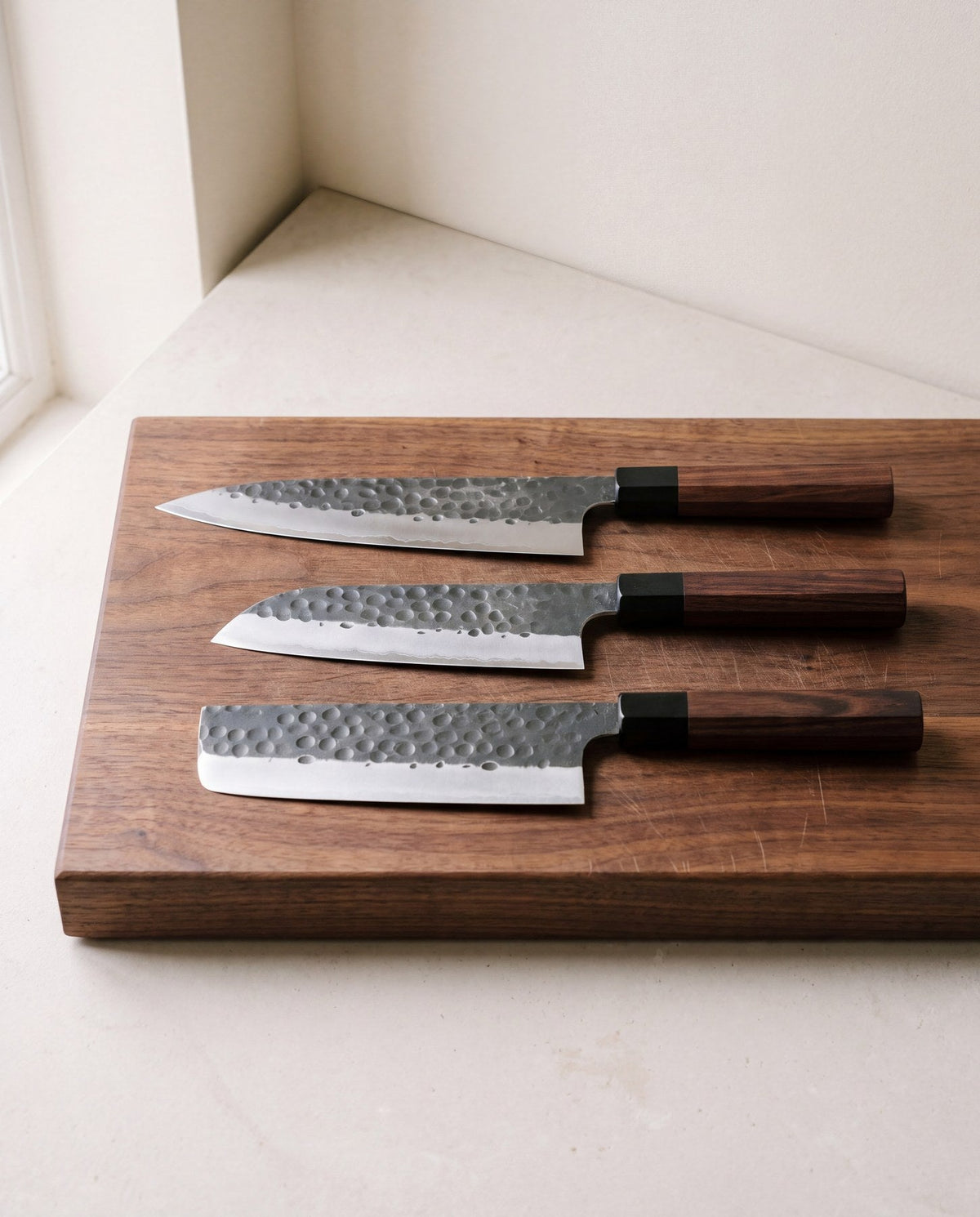
The Gyuto and the Santoku are the two most popular Japanese-style chef knives, and either one can be the only knife you reach for every day. Most home cooks start with an 8 inch Gyuto or a 7 inch Santoku. The difference is not quality. It is shape, length and the way you like to cut.
Short answer: Pick the Gyuto if you rock the knife and want one long blade for everything, large cuts of meat included. Pick the Santoku if you chop straight down and want a shorter knife that is easy to control.
Gyuto vs Santoku at a Glance
| Gyuto | Santoku | |
|---|---|---|
| Usual length | 8 in (ours run 6 to 9 in) | 7 in (ours run 5 to 7.5 in) |
| Profile | Long, gently curved edge, pointed tip | Flatter edge, spine curves down to the tip |
| Cutting motion | Rocking and long slicing strokes | Straight up-and-down chop |
| Typical weight | About 7 oz at 8 in | About 6 oz at 7 in |
| Best for | Meat, fish, large vegetables, herbs | Everyday vegetables, fast chopping |
| Pick it if | You already rock a Western chef knife | You want a compact first Japanese knife |
What Is a Gyuto?
The Gyuto is the Japanese-style version of the Western chef knife. It is long, usually 8 inches, with an edge that curves gently up to a fine point. That curve lets you rock the blade: the tip stays near the board while the heel lifts and falls. The length lets you slice through a roast or a fish fillet in one long stroke instead of sawing.
What Is a Santoku?
The Santoku is shorter, usually 7 inches, with a flatter edge and a spine that curves down to meet it at the tip. Its name is often translated as "three virtues": meat, fish and vegetables. Because the flat edge meets the board along more of its length, it suits a straight up-and-down chop and a forward push cut, which many cooks find easier to control.
How Each One Cuts
This is the difference you will feel most.
- Gyuto: rocking cuts and long slicing strokes. The curve pivots from heel to tip, which suits mincing herbs and garlic and slicing large cuts.
- Santoku: straight chops and push cuts. The flat edge lands squarely on the board, so thin slices separate cleanly and an even rhythm comes easily.
Neither motion is more correct. If you learned to cook with a Western chef knife, the Gyuto will feel familiar at once. If you usually chop straight down, the Santoku will.
Which Is Better for What?
Vegetables
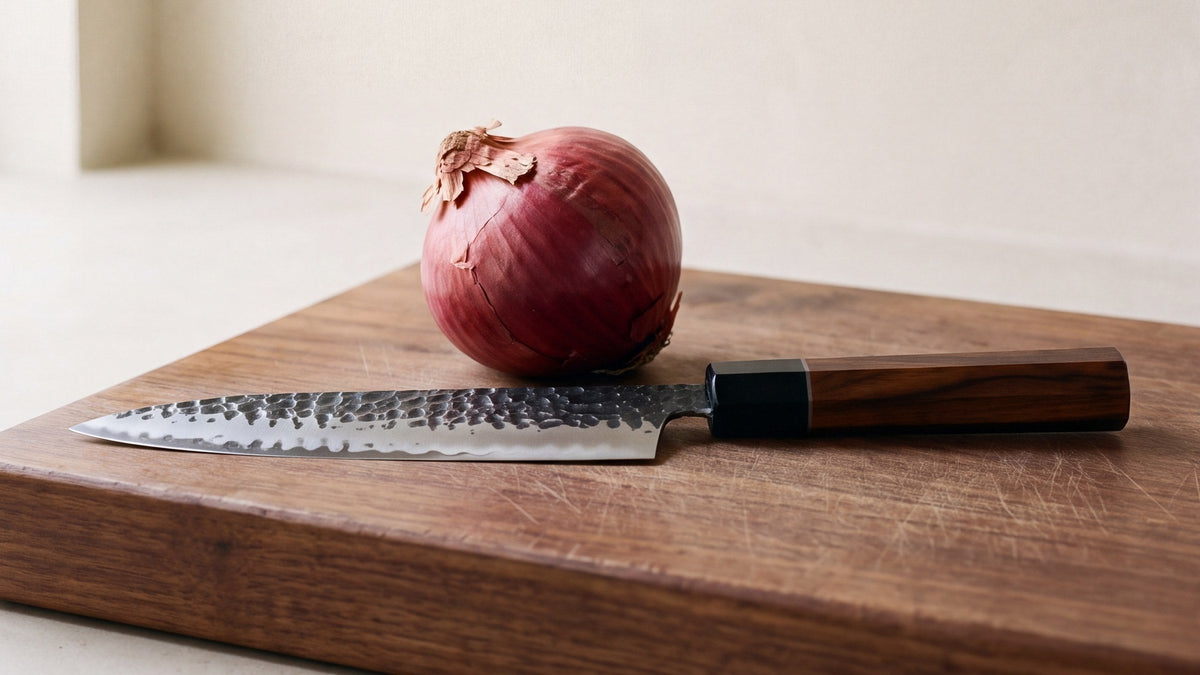
Both are very good. The Santoku's flat edge is made for fast, even chopping of onions, carrots, cucumbers and cabbage leaves. The Gyuto's extra length helps with large produce, such as halving a whole cabbage or a melon.
Meat and fish
The Gyuto has the edge here. A longer blade draws through a roast, a chicken breast or a salmon fillet in fewer strokes, and the pointed tip helps with trimming. A Santoku handles everyday meat and fish well; large cuts just take more strokes. Neither knife is for bones or frozen food.
Herbs and garlic
The Gyuto's curve makes rocking through herbs and garlic quick. With a Santoku you mince with short up-and-down chops, which works well once you have the rhythm.
Size, Board and Storage
An 8 inch Gyuto wants a cutting board with room for the full stroke. A 7 inch Santoku is happier on a smaller board and in a tight drawer, and if you have smaller hands the shorter blade often feels more natural. Our range also includes 5 inch Santoku knives and Gyuto knives up to 9 inches. For more on length, read How to Choose the Right Knife Size.
Same Steel, Same Care
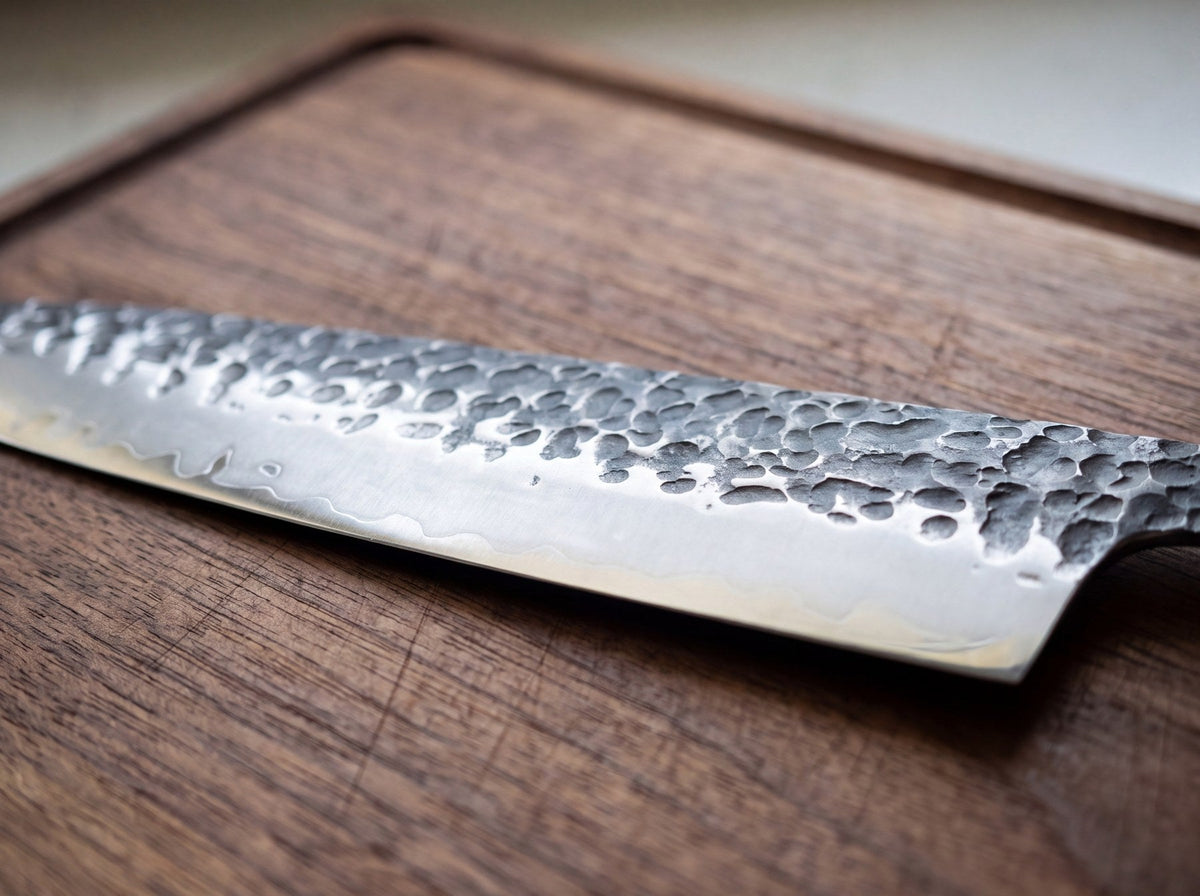
At HARUTANI both shapes are built the same way: a VG-10 steel core inside 67 layers of Damascus cladding, hardened to 60 ±2 HRC, with a hand-finished 12 to 15 degree edge on each side. So the choice is about shape and length, not quality. Most of our Santoku series also come as a Gyuto with the same handle, so you can add the second shape later as a matching pair.
Care is the same too: wash by hand, dry at once, cut on wood or plastic and sharpen on a whetstone. How to Care for a Japanese Knife covers the one-minute routine.
Which One Should You Pick?
Pick the Gyuto if
- You already use a Western chef knife and like to rock it.
- You often cook large cuts of meat or fish, or big vegetables.
- You want one long knife for almost every job.
Pick the Santoku if
- You prefer a straight up-and-down chop.
- Most of your prep is vegetables, and your board or drawer is on the small side.
- You want a shorter, lighter knife that feels controlled from the first cut.
Still unsure? Start with the shape that matches how you cut today. Plenty of cooks end up with both: a Gyuto for big jobs and a Santoku for quick weeknight prep, and a few of our knife duos pair the two in the same style. Browse all Gyuto knives or all Santoku knives.