Knife listings are full of steel terms: VG-10, HRC, Damascus, high-carbon, stainless. You do not need a metallurgy course to choose and look after a good knife. You need to know what each term means for three things you will notice in your kitchen: how long the edge stays sharp, how the blade reacts to water and acid, and how it behaves on a whetstone.
Short answer: HARUTANI knives use a VG-10 core, a high-carbon stainless steel, hardened to 60 ±2 HRC and wrapped in 67 layers of Damascus cladding. The hard core holds a thin edge well and resists rust far better than plain carbon steel. In return it asks for gentle use and a whetstone rather than a honing steel.
What Is VG-10 Steel?
VG-10 is a high-carbon stainless steel that is widely used for the cutting core of Japanese-style chef knives. In broad terms it contains about 1% carbon and about 15% chromium, plus small amounts of molybdenum, vanadium and cobalt.
- Carbon is what lets the steel be hardened, and hardness is what lets a thin edge stay sharp.
- Chromium is what makes it stainless: it helps the surface resist rust and staining.
- Molybdenum, vanadium and cobalt are small additions that help the steel take a fine, even edge and keep it stable.
The result is a steel that sits between two worlds: harder and finer-edged than a typical Western kitchen knife, but far easier to live with than a plain carbon steel blade.
What 60 ±2 HRC Means in Daily Use
HRC is the Rockwell C hardness scale. The test presses a diamond point into the steel and measures how deep it goes: the shallower the mark, the harder the steel and the higher the number. 60 ±2 HRC means the core is hardened to between 58 and 62. Hardness is one factor, not a performance score: the steel's composition, its heat treatment and the shape of the edge matter too.
| Hardness | Found in | What you notice |
|---|---|---|
| About 54 to 58 | Many Western-style kitchen knives | Forgiving; the edge tends to roll and needs touching up more often |
| 58 to 62 | HARUTANI's VG-10 core (60 ±2) | Holds a thin edge well; less forgiving of twisting and bones |
| 63 and up | Some very hard specialist steels | Supports very fine edges; durability and sharpening effort depend on the steel |
In practice, a harder edge keeps its bite through more meals before it needs the stone. The trade-off: under sideways force, a hard, thin edge may chip rather than roll. Twisting the blade in a squash or knocking it against bone is where that happens. That is why the everyday rules for a Japanese-style knife are about cutting with smooth strokes, on a wood or plastic board, and leaving bones and frozen food to a heavier tool.
What 67-Layer Damascus Cladding Does
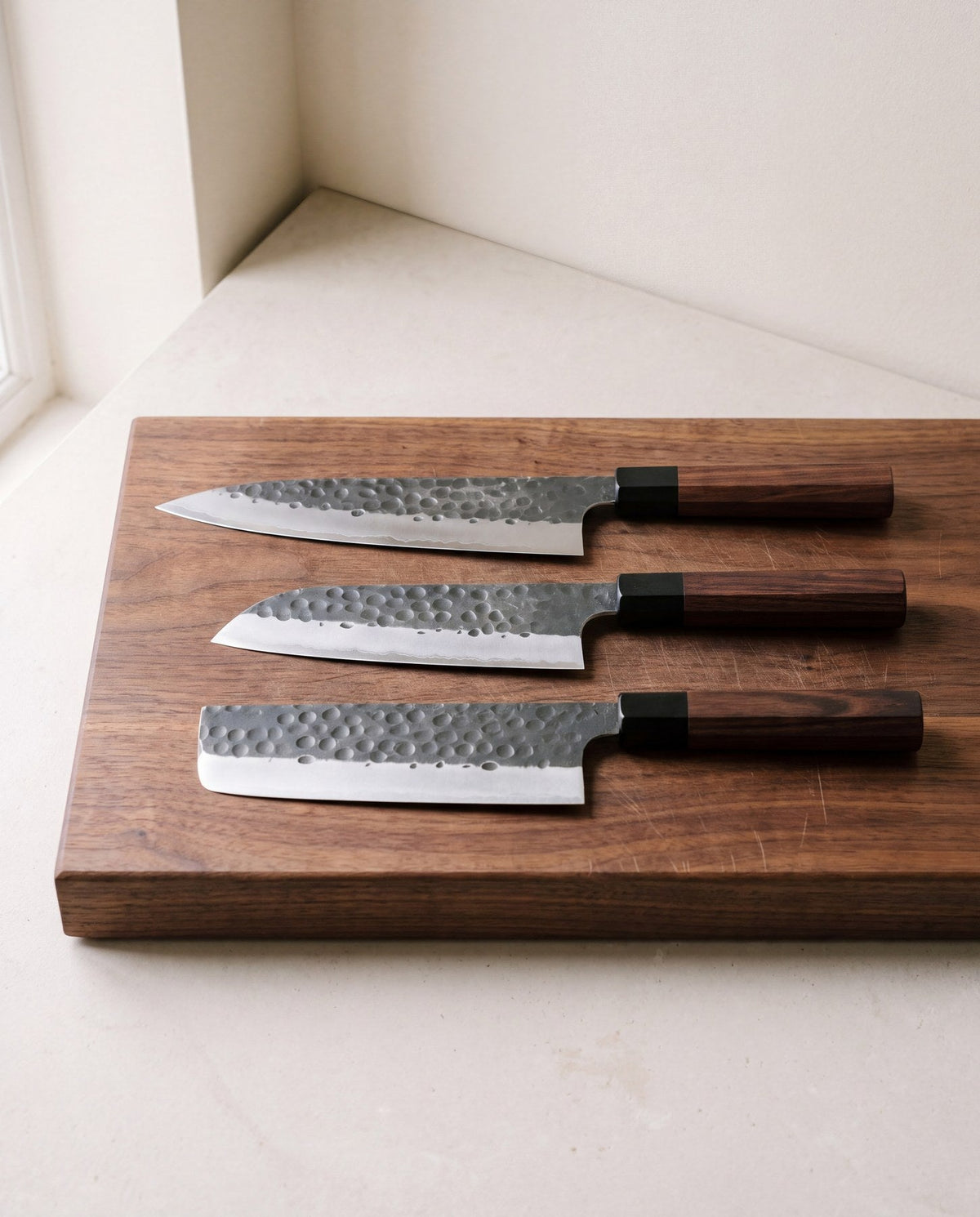
On a modern kitchen knife, "Damascus" describes layers of steel forged together and then etched, so the layers show as a flowing pattern on the blade face. On a HARUTANI knife, 67 layers of Damascus cladding wrap the VG-10 core. The core runs through the middle of the blade and forms the cutting edge; the cladding forms the sides.
- What it does: it forms the outer sides of the blade around the core and creates the visible layered pattern, so each blade has its own grain.
- What it does not do: the pattern does not make the edge sharper. Sharpness and edge life come from the VG-10 core and the way the edge is finished.
Treat the cladding kindly: steel wool and scouring powder scratch the finish, while a soft sponge and mild soap keep the pattern clear.
Stainless vs Carbon Steel: The Care Difference
Many Japanese-style knives are made from plain carbon steel, which has little chromium. It can take a very keen edge, but it rusts quickly if left wet and darkens into a patina with use. Stainless steels like VG-10 contain enough chromium to resist rust and staining much better. VG-10 does not normally develop a patina the way plain carbon steel does, though some discoloration is possible.
| Stainless (VG-10) | Plain carbon steel | |
|---|---|---|
| Rust | Resists it well, but is not rust proof | Rusts quickly if left wet |
| Patina | Not normally | Darkens with use |
| Oiling | Not needed | Often recommended |
Stainless does not mean care-free. Water, salt or acid left on the blade can still leave small spots over time, and a dishwasher is hard on any fine edge. The routine is simple: wash by hand with warm water and mild soap, dry at once, and store the knife so the edge never touches metal. Our guide on how to care for a Japanese knife covers it step by step.
How Steel Changes Sharpening
Hardness and edge angle go together. Hard steel can hold a thinner edge without rolling over, which is why HARUTANI knives carry a hand-finished edge of 12 to 15 degrees on each side, thinner than most Western kitchen knives. That thin, hard edge has three consequences for sharpening.
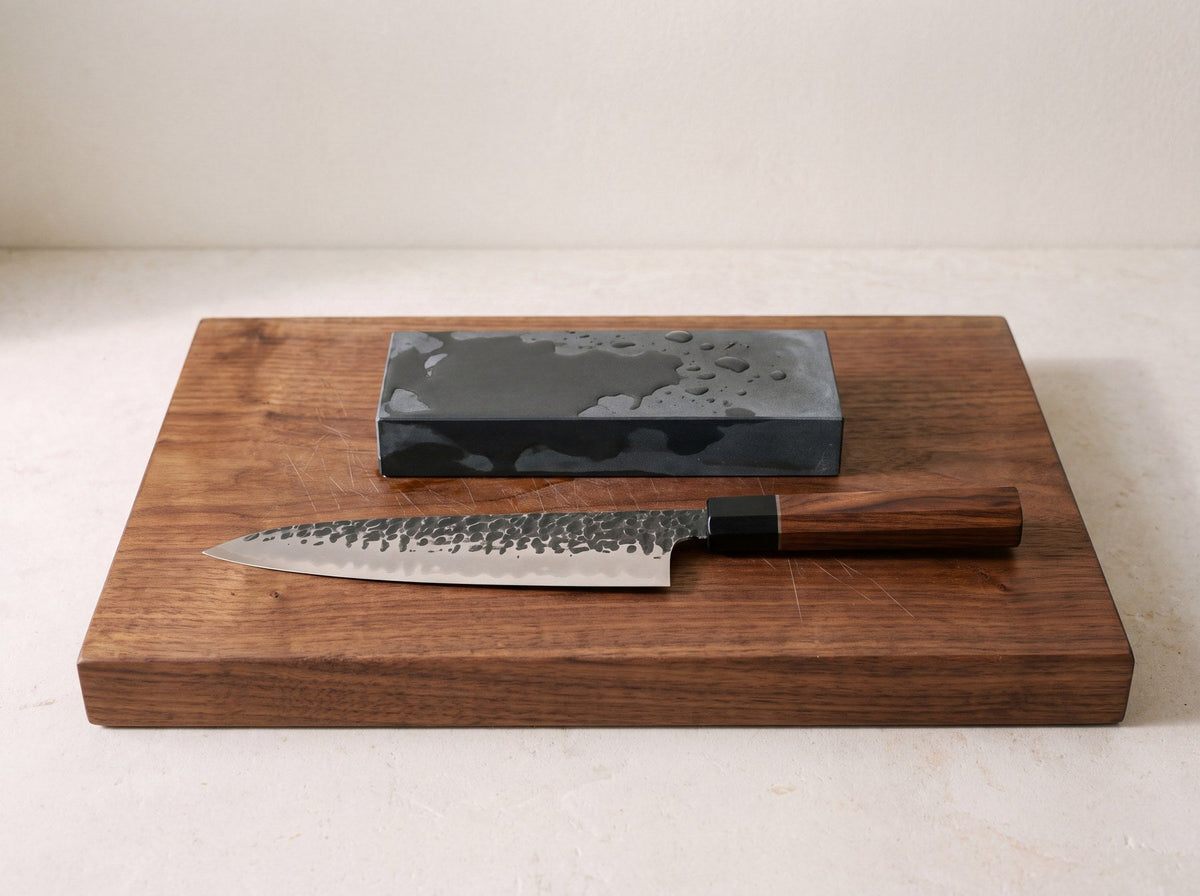
- Use a whetstone. A stone around 1000 grit sets the edge, and one in the 3000 to 6000 range polishes it. A hard edge can take a little longer on the stone than a soft one, so let the stone do the work rather than pressing harder.
- Skip the honing steel and the pull-through sharpener. A ridged honing steel can chip a hard edge, and most pull-through tools are set for a wider Western angle.
- Refresh gently. Between sharpenings, a few light strokes on a fine ceramic rod or a leather strop, at the same angle as the edge and with almost no pressure, bring back the bite.
Our guide on how to sharpen a Japanese chef knife walks through the angle, the grits and each stroke.
What HARUTANI Knives Use
Every HARUTANI knife is built on the same foundation, whatever the blade shape or handle:
| Part | HARUTANI |
|---|---|
| Core steel | VG-10, a high-carbon stainless steel |
| Hardness | 60 ±2 HRC |
| Cladding | 67 layers of Damascus steel |
| Edge | Hand-finished, 12 to 15 degrees on each side |
Because the steel is the same across the range, one care routine and one set of stones look after every knife in your block, from a Gyuto to a Nakiri or a Petty. That makes the choice about blade shape and size, not steel. Browse all HARUTANI knives to compare shapes.