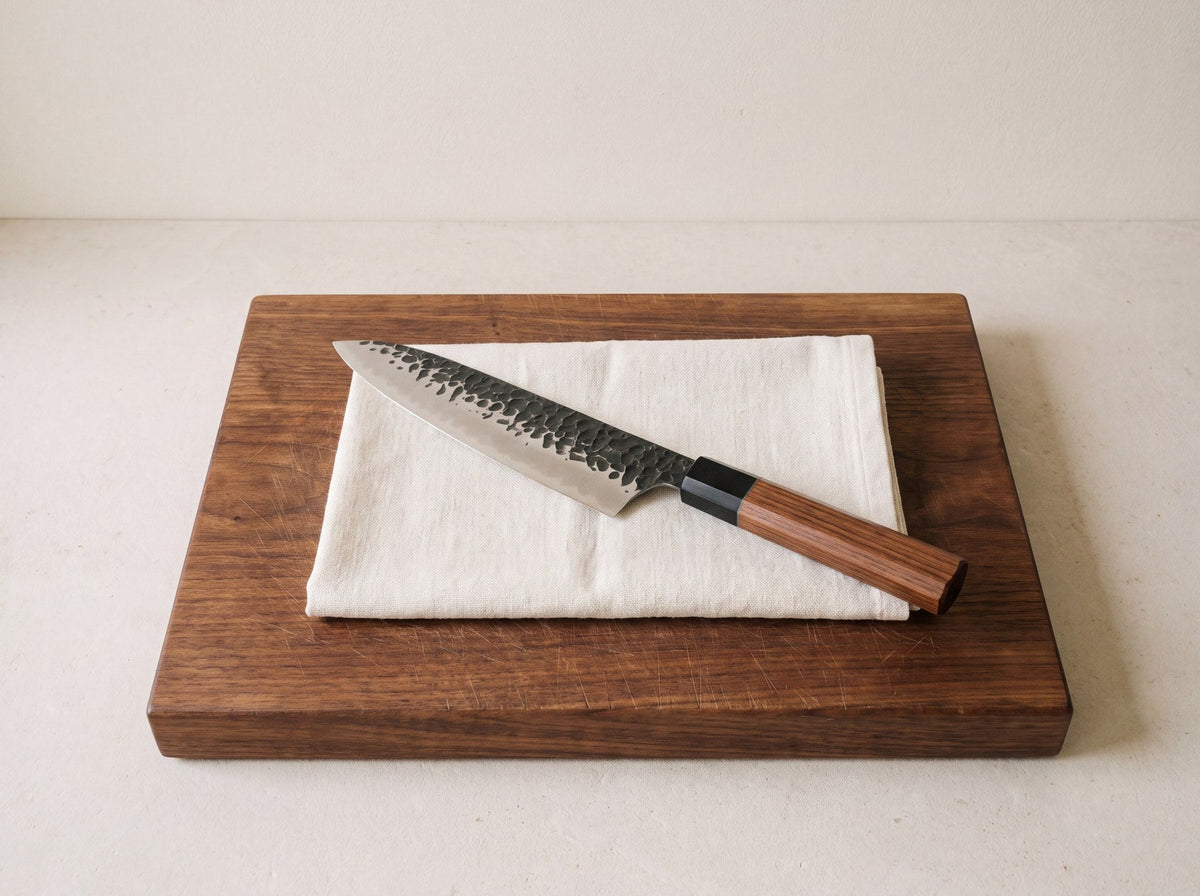
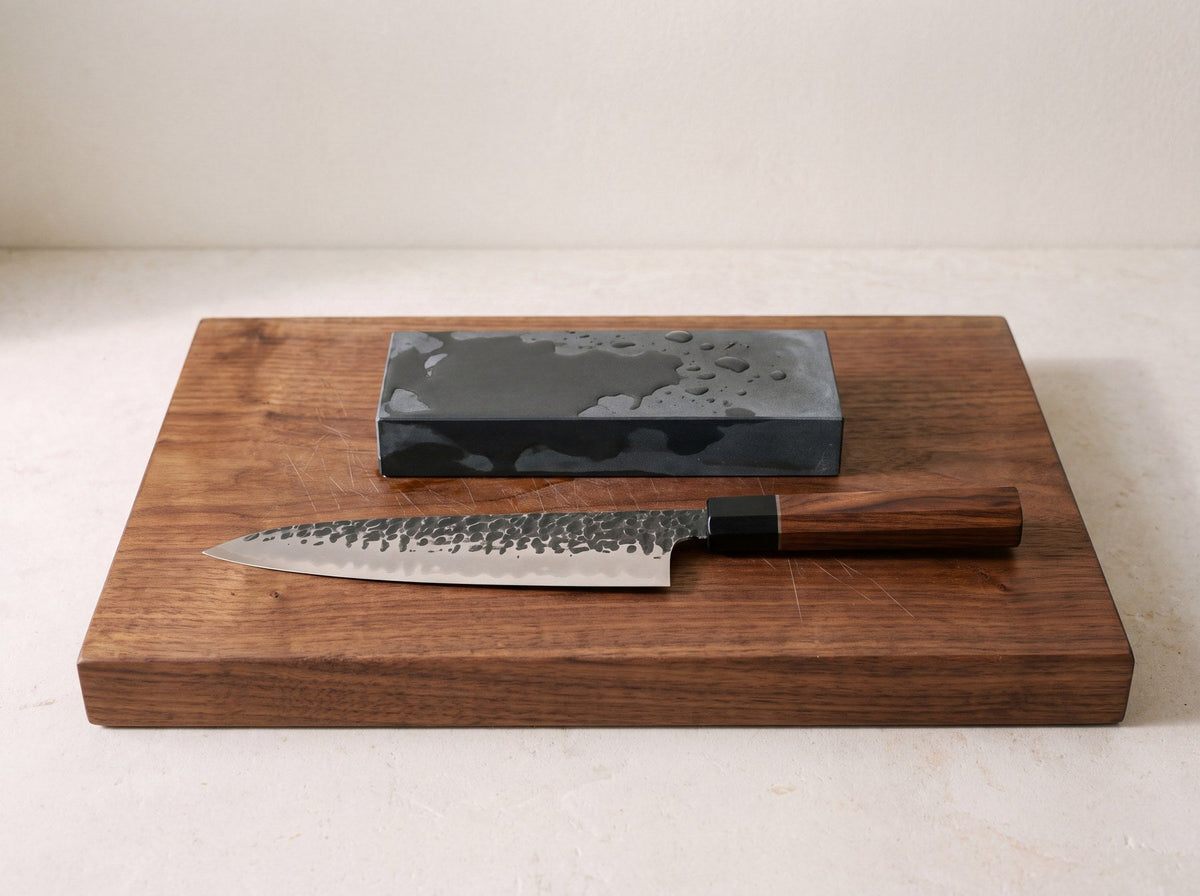
A lot of edge damage happens away from the cutting board: between meals, when a knife knocks against utensils, hard surfaces or another blade. A HARUTANI knife has a VG-10 steel core hardened to 60 ±2 HRC and an edge sharpened to 12 to 15 degrees on each side. That hard, thin edge stays sharp for a long time, but it chips more easily than a softer Western edge if it hits something hard.
The good news: any of four simple options keeps the edge safe. Here is how they compare.
Storage Options at a Glance
| Option | Best for | Watch for |
|---|---|---|
| Knife block | A set on the counter, always within reach | Slots long enough for your longest blade |
| In-drawer block | Small counters, knives out of sight | One knife per slot, handles clear the drawer |
| Magnetic strip | Free counter space, quick to grab | Spine first on, edge first off, mounted high |
| Blade guard (saya) | Travel, a single knife, any drawer | A snug fit, and only a dry knife goes in |
Never loose in a drawer. A loose knife can knock against utensils and other blades every time the drawer opens, chipping a hard, thin edge and putting your fingers at risk when you reach in.
Knife Block
A counter block holds each blade in its own slot, so edges never touch and every knife stays within reach while you cook. It suits anyone who keeps a set of three or more knives.
- Pros: keeps a whole set together, quick to use, nothing to mount.
- Cons: takes counter space, and the slots are hard to clean inside.
- Watch for: slot length and width. A 9 inch Gyuto needs a deeper slot than a Petty knife, and a tip pushed against the bottom of a short slot can bend or chip. Slide the knife in along its spine so the edge does not drag on the wood, and only put it away fully dry.
In-Drawer Block
An in-drawer block is a low tray with angled slots that sits inside a kitchen drawer. The knives stay out of sight and the counter stays clear. It does not keep children out on its own: for that, the drawer needs a child-safety lock.
- Pros: hidden away, no counter space, no drilling.
- Cons: needs a free drawer, and holds a fixed number of knives.
- Watch for: one knife per slot, blades fully seated, and enough height for the handles to clear the drawer above. A flat utensil organizer is not the same thing: if blades can touch or slide, it is still a loose drawer.
Magnetic Strip
A wall-mounted magnetic strip frees the counter and keeps every blade apart and in view. It is the storage shown in the photo above.
- Pros: saves space, easy to reach, blades never touch each other.
- Cons: knives are in reach of anyone tall enough, and a careless swipe can chip an edge.
- Watch for: how the blade meets the magnet. Place the spine against the strip first and roll the blade flat. To take it off, keep the spine on the strip, roll the edge away first, then lift the knife clear. Never slide the knife along the strip, and never let the cutting edge touch metal. A wood-faced strip is gentler on the blade. Mount it away from the stove and sink splash, out of reach of children, and check that it holds your heaviest knife firmly.
Blade Guard or Saya
A blade guard slips over the edge. A saya is the Japanese-style wooden sheath, usually held with a small pin. Either one lets a knife go in a drawer, a bag or a knife roll without the edge touching anything.
- Pros: low cost, portable, works for a single knife anywhere.
- Cons: one guard per knife, and it adds a step every time.
- Watch for: fit and moisture. The guard must match the blade length and shape: a Nakiri needs a different guard from a Gyuto, and a loose guard lets the blade rattle. Only a clean, fully dry knife goes in, because trapped moisture can leave spots on the steel.
Which One Should You Choose?
- One or two knives, small kitchen: a blade guard for each, or a compact in-drawer block.
- A full set, plenty of counter: a knife block sized for your longest blade.
- Short on counter space: a magnetic strip, mounted high.
- Children in the house: an in-drawer block in a drawer with a child-safety lock.
- Cooking away from home: a blade guard on every knife you pack.
What to Avoid
- Loose in a utensil drawer, or stacked on top of other knives.
- Left in the sink, the dish rack or the dishwasher basket.
- Put away wet, or wrapped in a damp towel or cloth.
- A guard or slot so tight that you have to force the blade in.
The Put-Away Habit
Storage only protects the edge if the knife gets there. After cooking, wash the blade by hand, dry it completely and put it straight back in its slot, on its strip or in its guard, rather than leaving it on the counter for later. Our guide on how to care for a Japanese knife covers the full one-minute routine.
A well stored edge needs the whetstone less often. When it is time, our guide on how to sharpen a Japanese chef knife walks through it step by step.