A Nakiri is a Japanese vegetable knife with a tall, rectangular blade and a flat cutting edge designed for controlled chopping, slicing, and dicing. Its full board contact and double-bevel geometry make it especially useful for cooks who prepare vegetables frequently and prefer straight or push-cutting motions.
What Is a Nakiri Knife?
The Nakiri is a Japanese vegetable knife designed specifically for preparing produce. Unlike an all-purpose Gyuto or Santoku, its shape is intentionally optimized for board-based vegetable preparation.
What “Nakiri” Means
The name Nakiri (菜切り) refers to vegetable cutting. Rather than being a general-purpose chef knife, the Nakiri is a specialist tool for chopping, slicing, dicing, and preparing vegetables.
That specialization comes from its geometry. A typical Nakiri has a tall, rectangular blade, a flat or nearly flat cutting edge, and a squared or gently rounded front rather than a pronounced pointed tip. Most modern Nakiri knives also use a double-bevel edge, making them accessible to both right- and left-handed cooks.
The blade is generally thin and relatively tall. The thin geometry helps the edge move cleanly through vegetables, while the additional blade height provides useful knuckle clearance. The broad blade can also make it easier to transfer chopped vegetables from the cutting board.
The Shape That Defines a Nakiri
The defining feature is the relationship between the flat edge and the cutting board. Much of the edge can contact the board during a controlled downward or forward cutting motion. This makes the Nakiri particularly comfortable for cooks who favor precise chopping rather than a pronounced rocking motion.
Common Nakiri blades fall roughly within the 150–180mm range, with 165mm being a particularly common format for home kitchens.

What Is a Nakiri Knife Best Used For?
A Nakiri earns its place when vegetable preparation is a significant part of your cooking. Its flat edge and tall blade make it well suited to repetitive board work where consistent cuts matter.
Vegetables a Nakiri Handles Particularly Well
A Nakiri works especially well with onions, cabbage, napa cabbage, carrots, daikon, radishes, cucumbers, leafy greens, scallions, eggplant, herbs, and other everyday vegetables.
Its geometry supports several common preparation tasks:
- Slicing: controlled cuts through vegetables such as cucumbers, carrots, and daikon.
- Dicing: precise downward cuts through onions and other firm produce.
- Julienne: repeated straight cuts for uniform vegetable strips.
- Chopping: efficient preparation of cabbage, leafy greens, herbs, and similar ingredients.
- Mincing: controlled repetitive cuts when preparing herbs and finely chopped vegetables.
- Shredding: particularly useful with cabbage and leafy vegetables.
The tall blade also gives the Nakiri a useful advantage when working with larger vegetables. More blade height provides knuckle clearance and creates a broad surface for moving prepared ingredients.
Nakiri Vegetable Use-Case Table
| Vegetable or task | Nakiri suitability | Why |
|---|---|---|
| Onions | Excellent | Flat edge supports controlled dicing |
| Cabbage | Excellent | Tall blade and broad edge suit repetitive chopping |
| Carrots | Excellent | Straight cuts produce consistent slices |
| Daikon | Excellent | Flat edge supports precise slicing |
| Cucumber | Excellent | Useful for controlled, uniform cuts |
| Leafy greens | Excellent | Efficient for repetitive chopping |
| Herbs | Very good | Compact blade supports controlled mincing |
| Large squash | Conditional | Dense produce can place greater demands on a thin edge |
| Boneless meat | Limited | Its geometry is optimized for vegetables rather than protein preparation |
| Bones or frozen food | Not suitable | Impact can damage a fine cutting edge |
Despite its rectangular appearance, a Nakiri should not be treated as a small cleaver. It is not designed for bones, frozen foods, forceful impact, or prying. Its strength is controlled vegetable preparation, not heavy chopping.
Nakiri vs. Santoku vs. Usuba: Which Japanese Vegetable Knife Fits You?
Nakiri, Santoku, and Usuba can all appear in discussions about Japanese vegetable preparation, but they serve different purposes.
Nakiri vs. Santoku
A Nakiri is the more specialized vegetable knife. Its flatter edge and taller rectangular blade favor straight chopping and push-cutting, with extensive edge contact against the board.
A Santoku, by contrast, is designed as a compact all-purpose knife. Its profile can accommodate vegetables as well as boneless meat and fish, making it a practical choice when one knife needs to handle a wider range of ingredients.
Choose a Nakiri when vegetable preparation is a major part of your cooking and you prefer a dedicated shape. Choose a Santoku when versatility matters more than specialization.
Nakiri vs. Usuba
The Nakiri and Usuba are more closely related in purpose because both are associated with vegetable preparation. Their construction and intended use, however, are different.
A Nakiri is generally double-beveled, making it comparatively straightforward for everyday cooks to use and maintain. A traditional Usuba is single-beveled and associated with more specialized Japanese vegetable techniques.
Usuba knives are particularly associated with techniques such as katsuramuki, where vegetables are cut into very thin continuous sheets. The single-bevel geometry requires a different handling and sharpening approach.
An Usuba is therefore not simply a “better Nakiri.” It is a different tool intended for a different level and style of vegetable preparation.
Quick Comparison
| Feature | Nakiri | Santoku | Usuba |
|---|---|---|---|
| Primary role | Vegetable specialist | All-purpose | Professional vegetable work |
| Edge | Flat / nearly flat | Slightly curved | Flat |
| Bevel | Double | Double | Single |
| Tip | Squared / rounded | Blunt, usable front | Traditional squared profile |
| Best motion | Push/chop | Push/chop and draw cuts | Traditional vegetable techniques |
| Ideal user | Vegetable-heavy cooks | General home cooks | Experienced Japanese knife users |
If you are comparing Japanese knife shapes more broadly, a dedicated guide to Gyuto vs. Santoku can help place the Nakiri alongside other everyday options.
How to Choose Japanese Knives Nakiri
Choosing a Nakiri is less about finding a single “best” specification and more about matching the knife's dimensions and construction to how you actually cook.
Choose the Right Blade Length
Nakiri knives commonly fall in the 165–180mm range.
A 165mm Nakiri is a practical starting point for many home kitchens. It offers a useful balance of cutting area and maneuverability without requiring a particularly large cutting board.
A 180mm blade provides additional reach and can be useful when preparing larger vegetables or working through higher volumes of produce.
Your choice should also consider:
- Hand size
- Cutting-board dimensions
- Typical vegetable size
- Amount of food prepared at one time
- Available workspace
- Personal cutting style
A shorter blade may feel easier to control on a compact board, while a longer blade can make large vegetables and higher-volume preparation more efficient. There is no universally correct Nakiri length.
Understand Steel and Hardness
Steel affects maintenance, sharpening behavior, corrosion resistance, and edge characteristics.
Stainless steel is generally convenient for everyday kitchen use because it requires less attention to moisture and corrosion. This can be particularly practical when regularly working with wet or acidic vegetables.
Carbon steel can offer excellent sharpening characteristics but requires more care to prevent corrosion and staining.
VG-10 is a commonly used stainless knife steel and is found in many Japanese kitchen knives. However, the steel name alone does not determine how a knife will perform.
HRC hardness is a measurement of hardness. A higher hardness figure does not automatically mean a better knife. Heat treatment, blade geometry, edge thickness, toughness, and intended use also influence how a knife behaves at the cutting board.
For a deeper explanation of these factors, see the Japanese knife steel guide.
Look at Grind, Thickness, and Edge Geometry
For a Nakiri, the geometry behind the cutting edge can be just as important as the steel designation.
A thin edge can move through vegetables with less resistance and provide a precise cutting feel. However, thinner geometry also means the edge should be used with appropriate technique. Twisting, prying, or striking hard materials can damage a fine edge regardless of the steel used.
Blade thickness and edge angle are also different specifications. A thicker blade is not necessarily dull, and a thin blade is not automatically more durable. Consider how the grind, thickness, edge geometry, and heat treatment work together.
Consider Handle, Height, Weight, and Balance
Ergonomics become increasingly important when a knife is used for repetitive vegetable preparation.
Japanese wa-style handles and Western-style handles offer different shapes and handling characteristics. Neither is universally better; grip preference and hand size matter.
Blade height is another practical consideration. A taller Nakiri can provide more clearance for the guide hand while also giving you a broad blade surface for transferring chopped vegetables.
Weight and balance are similarly personal. Some cooks prefer a lighter, agile knife for repetitive preparation, while others appreciate additional mass when cutting dense vegetables. The best balance is the one that feels controlled and comfortable throughout a full prep session.

How to Use a Nakiri Knife Correctly
The Nakiri's flat edge works best when you use the cutting motions its geometry was designed to support.
Use Straight Chopping and Push-Cutting
Start with a secure pinch grip and position the guide hand in a protected claw shape. For chopping, bring the blade down in a controlled vertical motion.
For slicing, a gentle forward-and-down push can move the edge through the vegetable while maintaining contact with the board.
Because the Nakiri has a flat or nearly flat edge, much of its cutting edge can meet the board. This is different from relying on a pronounced rocking motion.
The result can be particularly useful for repetitive vegetable preparation where uniform slices, strips, or dice are the goal.
Use the Tall Blade to Your Advantage
The tall profile provides useful knuckle clearance between the cutting board and the hand guiding the vegetable.
The broad blade can also help move chopped ingredients from the board into a bowl, pan, or container. Use the broad side of the knife for this purpose rather than scraping aggressively with the edge, which can unnecessarily wear the cutting edge.
What Not to Cut
Do not use a Nakiri for bones or frozen food. Avoid twisting, prying, or applying lateral force to the edge.
Dense vegetables such as large squash require additional care. If cutting demands substantial force, reconsider the cutting position and technique rather than forcing the blade through the ingredient.
The rectangular profile may resemble a small cleaver, but the Nakiri's fine edge is intended for controlled vegetable work—not impact cutting.
Nakiri Knife Care and Sharpening
A Nakiri's fine vegetable edge benefits from simple, consistent maintenance.
Daily Nakiri Care
Hand wash the knife after use and dry it promptly. Avoid leaving it submerged in water or placing it in a dishwasher.
Use a suitable cutting board, such as wood or an appropriate softer synthetic surface. Avoid very hard surfaces such as glass or stone, which can accelerate edge damage.
Store the knife safely so the cutting edge does not contact other utensils.
Sharpening a Nakiri
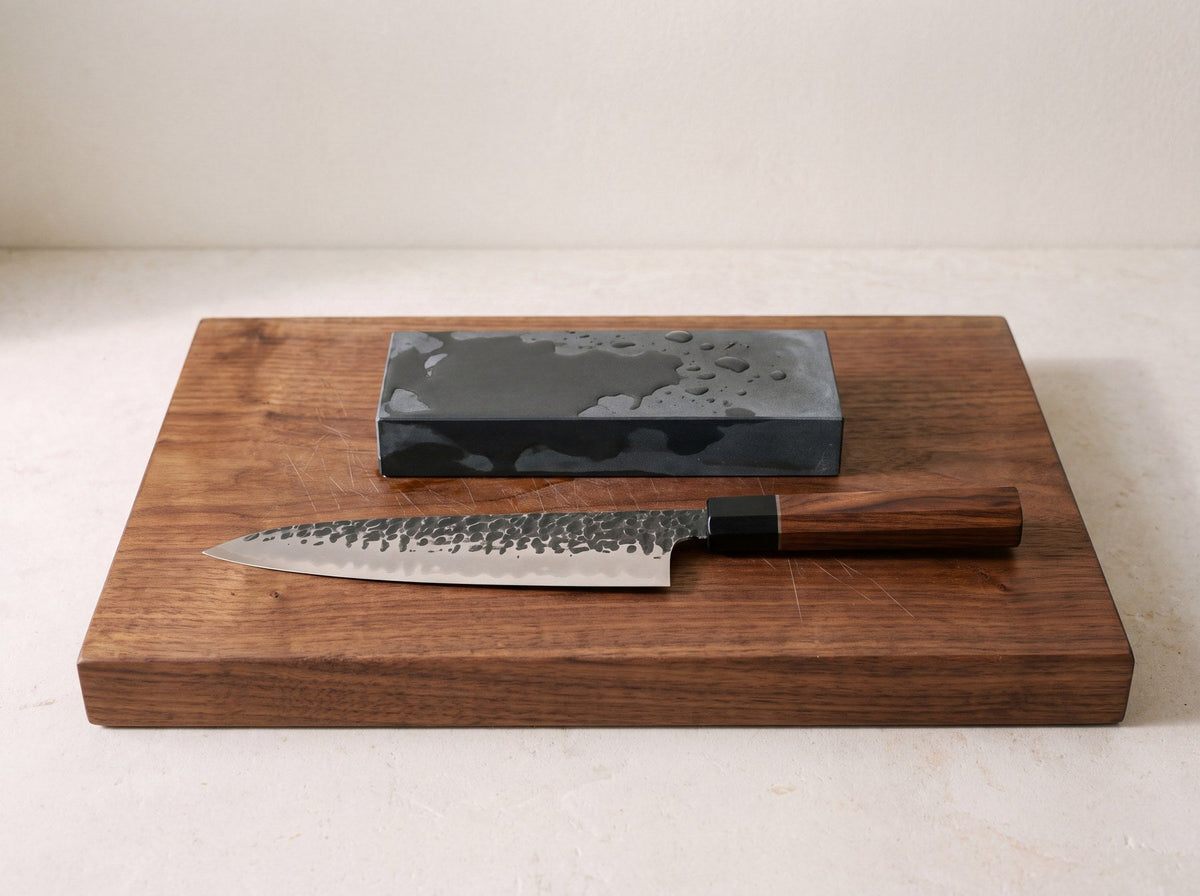
Sharpening restores the geometry of the cutting edge as it becomes worn through use. A whetstone is a suitable sharpening method for many Japanese kitchen knives.
The Nakiri's relatively straight edge can make it easier to maintain consistent contact with a sharpening stone than a strongly curved blade.
There is no universal sharpening schedule. Frequency depends on how often the knife is used, the cutting board, technique, food preparation volume, and the condition of the edge.
For more detailed maintenance instructions, see a Japanese knife care guide or Japanese knife sharpening guide.
Who Should Buy a Nakiri Knife?
A Nakiri makes sense when its specialized geometry matches the way you cook.
A Nakiri Makes Sense If You:
- Prepare vegetables frequently.
- Cook vegetable-heavy or plant-forward meals.
- Prefer straight chopping or push-cutting.
- Want consistent, repeatable vegetable cuts.
- Value a tall blade and broad cutting surface.
- Already own a Gyuto or Santoku and want a dedicated vegetable knife.
Consider Another Knife If You:
- Need one knife for meat, fish, and vegetables.
- Frequently work around bones or joints.
- Prefer a pronounced rocking motion.
- Need a pointed tip for trimming and detail work.
- Rarely prepare vegetables.
The simplest decision rule is:
Choose a Nakiri for vegetable specialization; choose a Santoku or Gyuto when versatility is more important.
A Nakiri does not have to replace another chef knife. For many cooks, its value is that it adds a capability the existing knife does not provide as efficiently.
What Makes a HARUTANI Nakiri Different?
HARUTANI's Nakiri is designed around the same fundamental principle that defines the shape: controlled vegetable preparation through a straight cutting profile and dedicated blade geometry.
Geometry Built Around Vegetable Preparation
The 6-inch Nakiri provides a compact format for board-based vegetable work. Its straight profile is suited to the controlled chopping and slicing motions associated with the Nakiri shape.
The tall blade also provides useful clearance for the guide hand and creates a broad surface for moving prepared vegetables from the cutting board.
Rather than treating the Nakiri as a smaller version of a cleaver, HARUTANI positions the shape as a dedicated vegetable knife within its Japanese knife range.
Steel, Construction, and Finish
HARUTANI's current Nakiri construction uses:
- VG-10 core steel
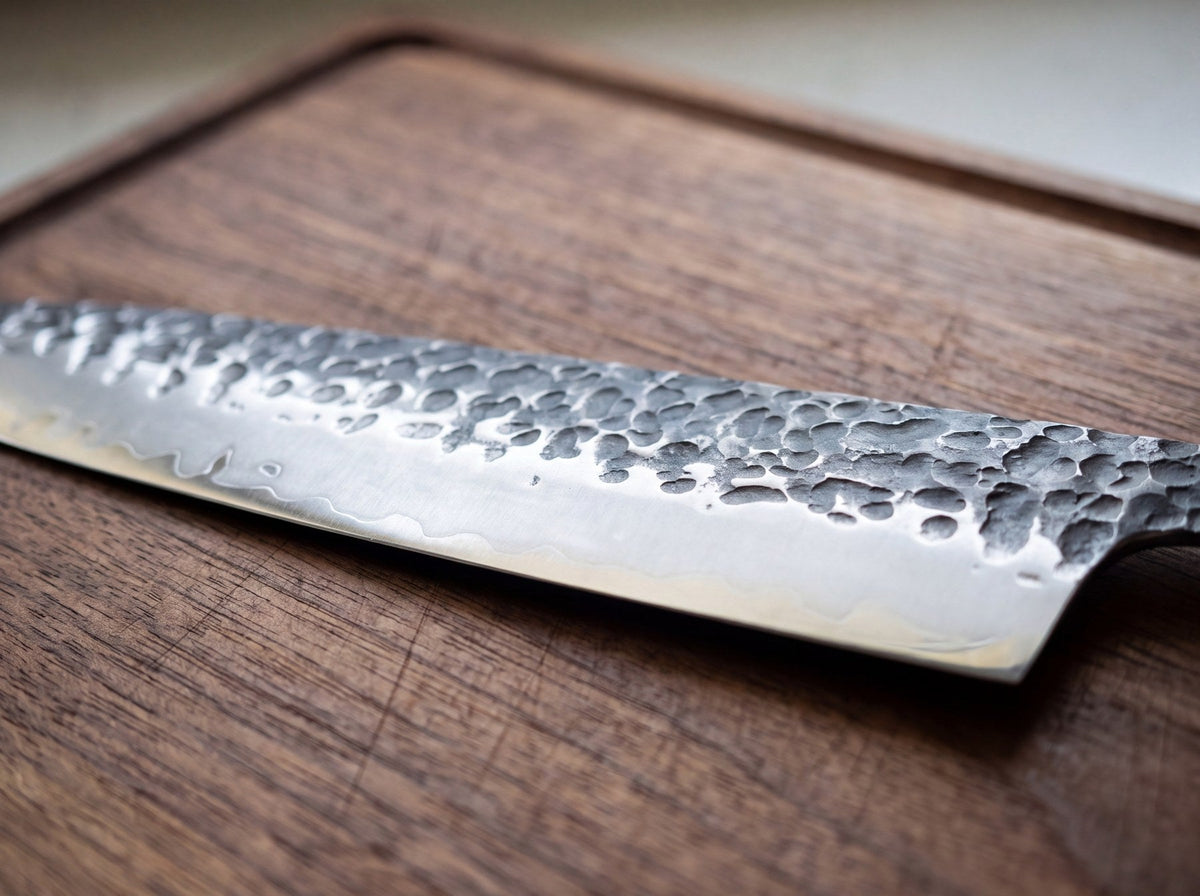
- 67-layer Damascus cladding
- 60 ±2 HRC hardness
- Approximately 15° per-side edge geometry
- Seki, Japan craftsmanship
The VG-10 core forms the cutting steel, while the Damascus layers provide the visible cladding around it. The 60 ±2 HRC specification describes the hardness of the blade steel, while the approximately 15° per-side geometry describes the intended edge angle.
These specifications should be understood as parts of the knife's overall construction rather than isolated indicators of performance. Steel, heat treatment, grind, thickness, edge geometry, balance, and handling all contribute to how a Nakiri feels in actual vegetable preparation.
Explore the HARUTANI Nakiri collection to compare the available dedicated vegetable knives.

Build Your Japanese Knife Set Around a Nakiri
A Nakiri can serve as the vegetable specialist within a deliberately small Japanese knife collection.
- Nakiri: dedicated vegetable preparation
- Gyuto: broad all-purpose preparation
- Santoku: compact everyday versatility
- Petty: small and detailed work
The goal is not to collect overlapping blade shapes. It is to choose knives that perform different jobs well.
For a broader overview, start with a complete Japanese chef knives guide, then use the Nakiri as the specialist option when vegetable preparation deserves its own blade.
Frequently Asked Questions
What is a Nakiri knife used for?
A Nakiri is primarily used for vegetables. Its flat edge and tall rectangular blade are well suited to chopping, slicing, dicing, julienning, mincing, and other board-based vegetable preparation.
Is a Nakiri better than a Santoku?
Neither is universally better. A Nakiri is more specialized for vegetable preparation because of its flat edge, while a Santoku offers greater versatility across vegetables, boneless meat, and fish.
Can you cut meat with a Nakiri knife?
A Nakiri can technically slice some boneless meat, but it is not designed for general meat preparation, trimming around bones, or heavy cutting. A Santoku or Gyuto is generally more appropriate when protein preparation is a regular part of your cooking.
What size Nakiri knife should I buy?
The common range is approximately 165–180mm. A 165mm Nakiri is a practical choice for many home kitchens, while 180mm can provide additional reach for larger vegetables, larger boards, or higher-volume preparation.
What is the difference between a Nakiri and an Usuba?
A Nakiri is generally double-beveled and intended for accessible everyday vegetable preparation. A traditional Usuba is single-beveled and associated with more specialized Japanese vegetable techniques, including katsuramuki.