A Japanese Santoku knife is a compact, double-bevel all-purpose blade designed for everyday cutting of vegetables, meat, and fish. Its relatively short, broad blade and flatter edge favor controlled chopping and push-cutting, making it particularly useful for cooks who want precision and maneuverability.
What Is a Japanese Santoku Knife?
A Santoku is a Japanese all-purpose kitchen knife designed to handle many of the ingredients found in everyday cooking. Its compact proportions distinguish it from longer chef's knives while giving it enough blade surface for efficient preparation.
What “Santoku” Means
The Japanese term Santoku (三徳) is commonly translated as “three virtues,” referring traditionally to the knife's versatility with meat, fish, and vegetables. The name is best understood as describing its general-purpose role rather than suggesting that a Santoku can replace every specialist knife.
This versatility is one reason Japanese Santoku knives work well as an everyday primary blade. A single knife can handle tasks such as dicing onions, chopping vegetables, mincing herbs, slicing boneless meat, and preparing fish.
The Shape That Defines a Santoku
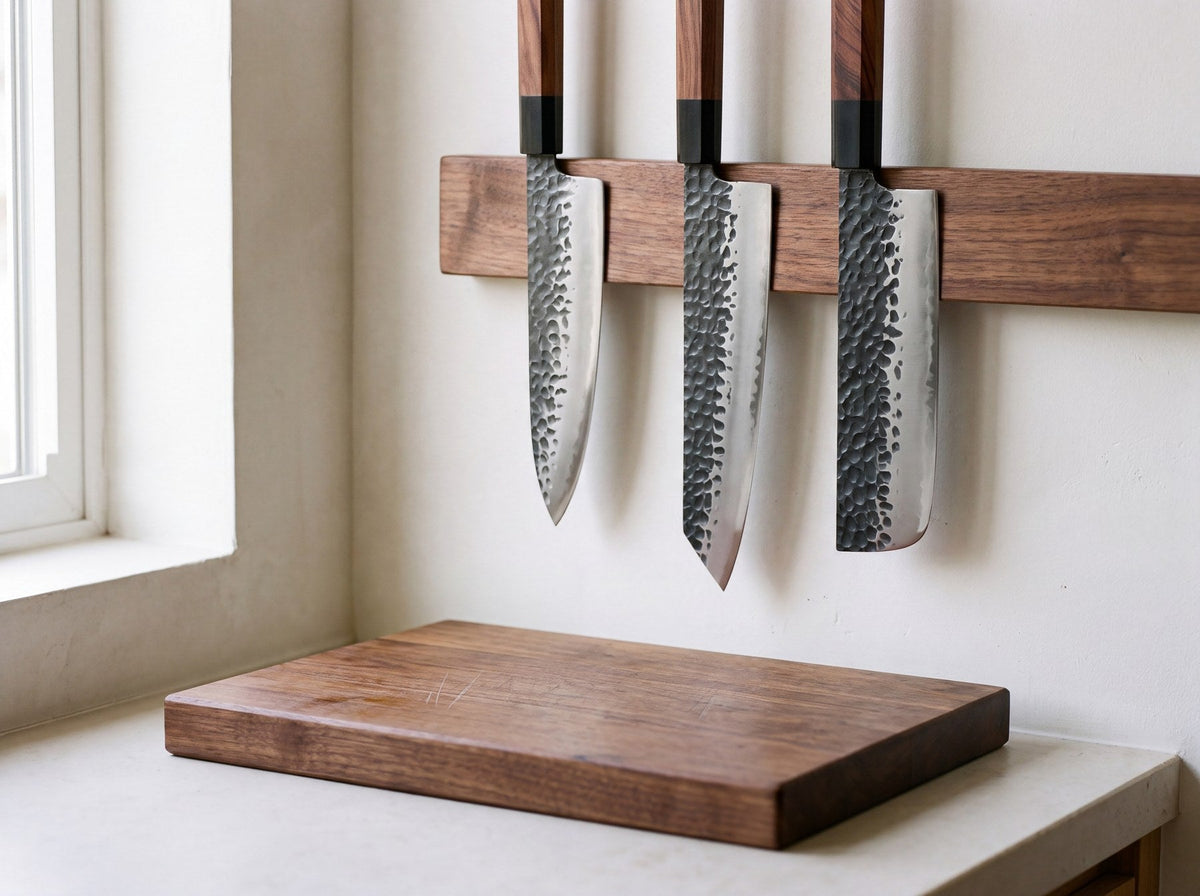
A typical Santoku has a shorter blade, broad blade face, relatively flat cutting edge, and gently downturned tip. Many Santoku knives made for Western kitchens also use a double-bevel blade, meaning both sides of the edge are sharpened.
The geometry affects how the knife moves through food. Its flatter edge provides substantial contact with the cutting board during controlled chopping and push-cutting, while the shorter blade offers maneuverability and visibility during detailed preparation.
The result is a santoku japanese knife that feels compact and responsive rather than long and sweeping. Understanding that geometry is important because the knife's shape should influence both how you cut and which ingredients you choose to prepare with it.

What Is a Santoku Knife Best Used For?
A Santoku is particularly well suited to everyday ingredients and repeated cutting tasks. Vegetables, herbs, fruit, boneless meat, and prepared fish are all natural applications for its compact, relatively flat geometry.
Everyday Ingredients a Santoku Handles Well
A Santoku works especially well for onions, carrots, cabbage, leafy greens, herbs, fruit, and aromatics. Its controlled edge also makes it useful for slicing boneless chicken, pork, or beef and portioning prepared fish fillets.
Common motions include slicing, dicing, chopping, and mincing. The knife is particularly comfortable when the cook uses controlled forward-and-down or push-cutting motions rather than relying heavily on a continuous rocking action.
Santoku Use-Case Table
| Kitchen task | Santoku suitability | Why |
|---|---|---|
| Vegetable chopping | Excellent | Broad, relatively flat edge |
| Dicing onions | Excellent | Controlled vertical and push cuts |
| Herb preparation | Excellent | Compact, agile blade |
| Boneless meat | Very good | Short blade gives control |
| Fish fillets | Very good | Useful for thin slicing and portioning |
| Large roasts | Limited | Less blade length |
| Bone cutting | Not suitable | Requires a dedicated heavier blade |
| Frozen food | Not suitable | Can damage the edge |
| Rock-chopping | Limited | Flatter profile is not optimized for it |
The important distinction is that “all-purpose” does not mean “suitable for everything.” A fine-edged Santoku is not a cleaver, boning knife, or frozen-food blade. Using it outside its intended role can damage the edge or make cutting less controlled.
Santoku vs. Gyuto vs. Nakiri: Which Japanese Knife Fits Your Cooking?
Choosing between Japanese knife shapes becomes easier when you consider the way you prepare food rather than simply comparing specifications.
Santoku vs. Gyuto
A Santoku is generally shorter and flatter, making it particularly comfortable for controlled chopping and push-cutting. A Gyuto typically provides a longer blade, greater reach, a more pronounced curve, and a pointed tip.
That difference matters when cutting motion becomes part of your preference. A cook who likes compact, controlled cuts may prefer a Santoku, while someone who regularly uses draw cuts, rocking motions, or works with larger ingredients may find a Gyuto more natural.
For a detailed comparison, see the Santoku vs Gyuto guide.
Santoku vs. Nakiri
Both knives can be excellent choices for vegetable-heavy cooking, but their roles differ. A Nakiri is more specialized for vegetables and has an especially flat edge. A Santoku adds greater versatility for meat and fish.
| Feature | Santoku | Gyuto | Nakiri |
|---|---|---|---|
| Primary role | Everyday all-rounder | Broad all-purpose chef knife | Vegetable specialist |
| Typical feel | Compact and controlled | Longer and more versatile | Stable and vegetable-focused |
| Edge profile | Relatively flat | More curved | Very flat |
| Best motion | Push/chop | Push, draw, rock | Push/chop |
| Best for | Mixed everyday prep | Larger, varied prep | Produce-heavy kitchens |
For many cooks, the Santoku makes sense as a first Japanese knife because it balances versatility, maneuverability, and everyday usability.
How to Choose Japanese Santoku Knives
The best Santoku is not necessarily the one with the highest hardness rating, most elaborate Damascus pattern, or longest blade. Start with the specifications that directly affect how the knife will feel in your kitchen.
Choose the Right Blade Length
Common Santoku sizes generally fall within the 165–180mm range. A 165mm blade favors maneuverability and can work particularly well on smaller cutting boards. Around 170mm provides a practical middle ground, while 180mm offers additional reach for larger preparation areas.
There is no universally correct length. Consider your hand size, cutting-board dimensions, ingredient size, and typical preparation volume. A compact kitchen and frequent vegetable preparation may favor a shorter blade, while larger ingredients and more substantial prep may benefit from additional reach.
Understand Steel and Hardness
Knife steel affects several practical characteristics, including edge retention, sharpening behavior, corrosion resistance, and toughness. VG-10 steel is one commonly used stainless steel in Japanese kitchen knives.
You may also encounter an HRC hardness rating. HRC measures hardness; it should not be treated as a direct score for overall knife quality. Higher hardness can contribute to edge retention, but the complete cutting experience also depends on blade geometry, heat treatment, thickness, grind, and intended use.
For more detailed information, explore a Japanese knife steel guide or resource on understanding VG-10 steel.
Edge Angle and Blade Geometry
A finer edge can support precise cutting, but it also requires appropriate technique and care. HARUTANI's specifications use an edge range of approximately 12–15° per side, with product specifications listing approximately 15° per side.
Edge angle should not be considered in isolation. Blade thickness, grind, steel, and heat treatment all influence how an edge performs and how durable it is during everyday preparation.
Handle, Balance, and Construction
Handle design affects comfort and control. Wa-style handles and Western-style handles have different shapes and handling characteristics, so personal preference matters.
A pinch grip allows the cook to control the blade closer to its balance point, while the overall weight distribution influences how the knife feels during repeated cuts.
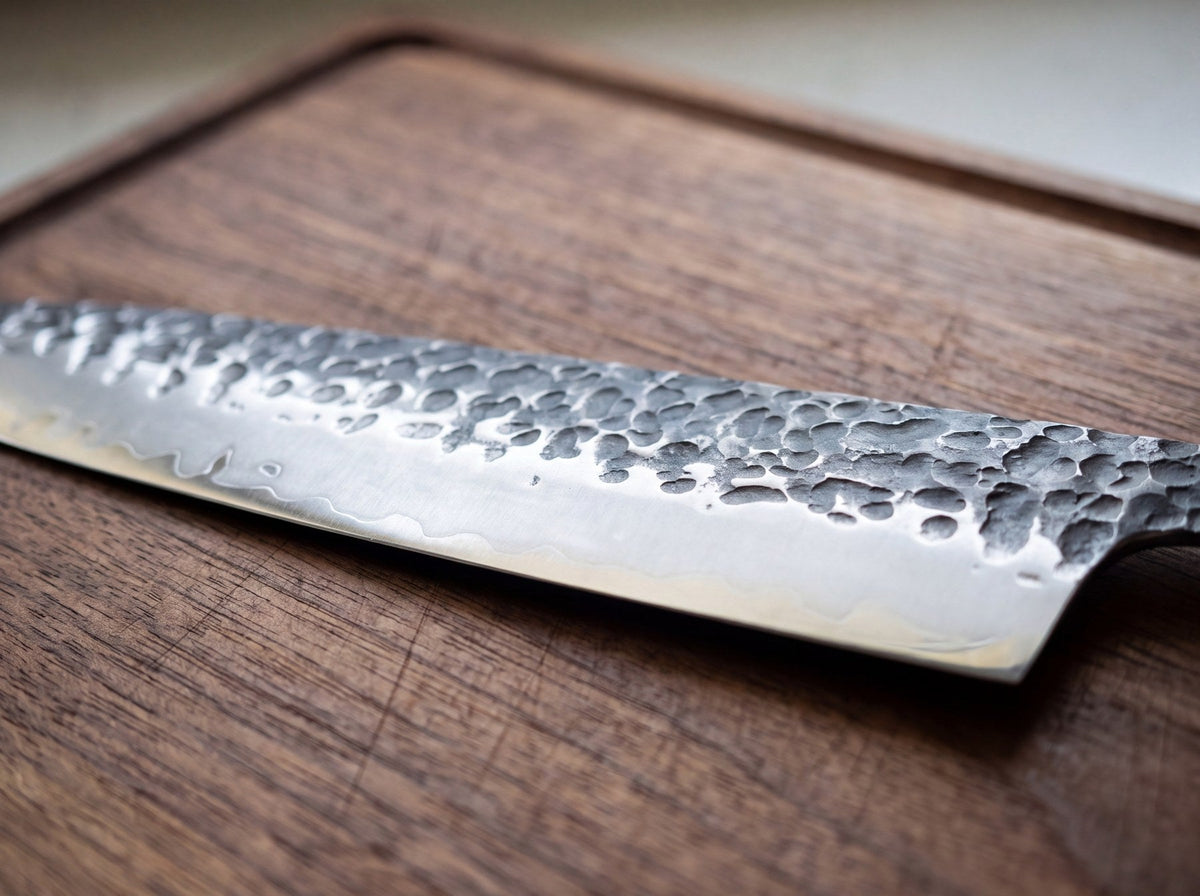
Also distinguish Damascus cladding from the cutting core. A Damascus pattern does not necessarily mean the cutting edge itself is made from Damascus steel. In HARUTANI's construction, the knife range uses a VG-10 core with 67-layer Damascus construction and 60 ±2 HRC hardness. The practical significance comes from the combination of core steel, construction, heat treatment, geometry, and edge specification—not the appearance alone.

How to Use a Santoku Knife Correctly
Santoku geometry is designed to work particularly well with controlled cutting techniques.
Push-Cutting and Controlled Chopping
With push-cutting, the blade moves forward and downward through the ingredient rather than simply being lifted and dropped. The relatively flat Santoku edge allows substantial contact with the board during this motion.
Controlled chopping can also feel natural because the blade does not rely on the pronounced curve found on some chef's knives. You can still use drawing motions when appropriate, but continuous rocking is generally less central to the Santoku's design.
Grip and Board Technique
A pinch grip around the blade near the bolster or heel provides control, while the non-dominant hand should keep fingertips protected in a claw position.
Use a stable cutting board and maintain controlled blade contact. Avoid twisting, prying, or forcing the blade through resistant material.
What Not to Cut
Do not use a fine-edged santoku japanese knife for bones, frozen food, or unusually hard materials outside its intended use. A Santoku should not be treated as a cleaver.
If a task requires significant force, striking, splitting, or bone work, use a knife designed for that purpose. Protecting the edge is part of using a Japanese knife correctly.
Santoku Knife Care and Sharpening
Proper maintenance helps preserve both cutting performance and the condition of the blade.
Daily Santoku Care
Hand wash the knife after use and dry it immediately. Use an appropriate cutting board rather than a hard surface that can be excessively demanding on a fine edge.
Do not leave the knife soaking in water, and avoid placing a Japanese kitchen knife in the dishwasher. Store it so the edge does not strike other utensils.
Sharpening a Japanese Santoku
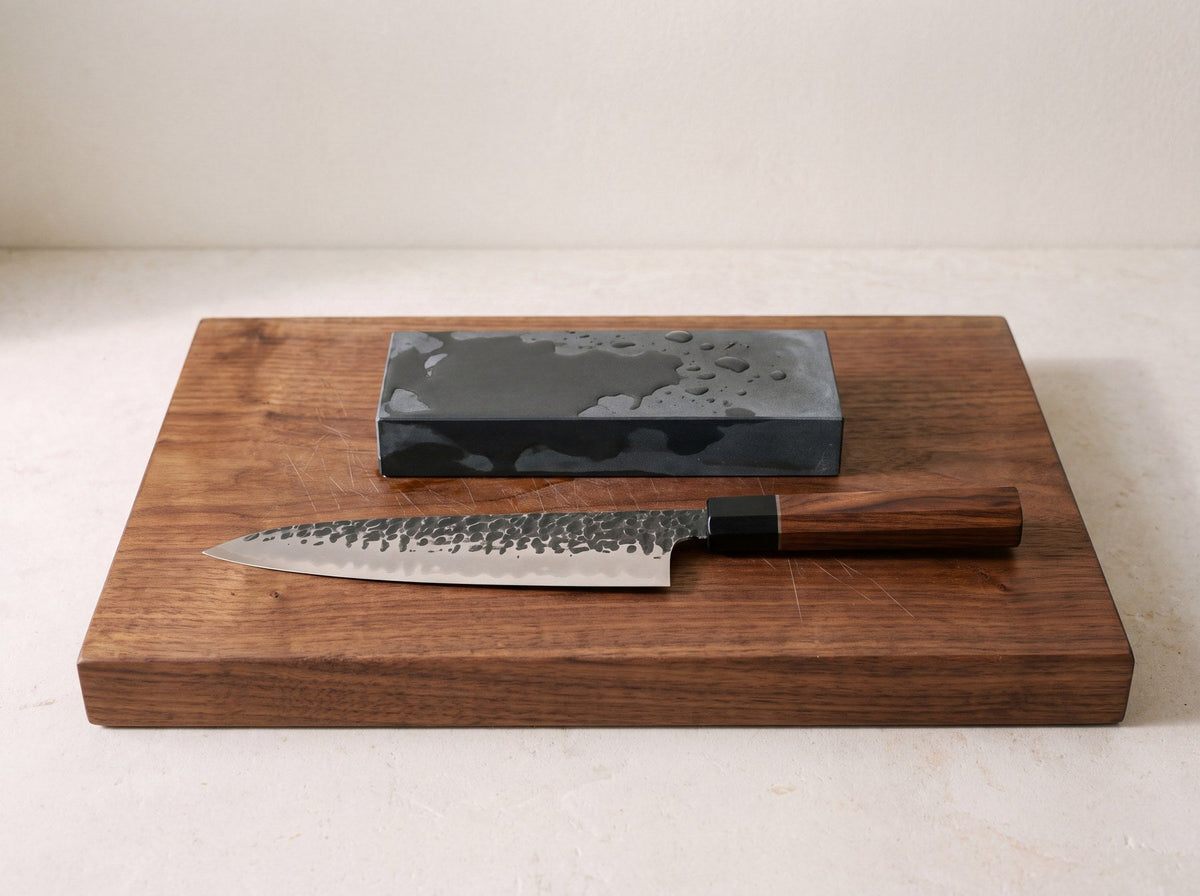
Sharpening restores the cutting edge; it does not make the steel harder. For fine Japanese edges, whetstone sharpening provides a controlled maintenance path when performed correctly.
There is no universal sharpening interval. How often a Santoku needs sharpening depends on how frequently it is used, what it cuts, the cutting board, technique, and how well the edge is maintained.
For more detail, see HARUTANI's resources on Japanese knife care and how to care for a Santoku knife.
Who Should Buy a Santoku Knife?
A Santoku is a strong choice when your everyday cooking revolves around controlled preparation rather than large-scale protein breakdown.
A Santoku Makes Sense If You:
-
Prepare vegetables frequently.
-
Prefer chopping or push-cutting.
-
Use a smaller cutting board or compact kitchen.
-
Want a shorter, highly maneuverable primary knife.
-
Want one blade for most everyday ingredients.
Its compact format can also make it approachable for cooks who find a longer chef's knife cumbersome.
Consider a Gyuto or Specialist Knife If You:
-
Frequently work with large cuts of meat.
-
Prefer a pronounced rocking motion.
-
Need a pointed tip for detailed work.
-
Break down whole proteins or bones.
-
Want greater reach for high-volume professional preparation.
The decision ultimately comes down to cooking style, cutting motion, ingredients, and workspace. If your needs are mixed and everyday-focused, a Santoku is often the most balanced starting point. If your work is more specialized, another Japanese knife shape may be a better fit.
What Makes a HARUTANI Santoku Different?
HARUTANI approaches the Santoku as an everyday working knife, with its compact format designed around controlled preparation and practical cutting performance.
Santoku Geometry for Everyday Prep
The 7-inch HARUTANI Santoku provides the compact blade format associated with the Santoku category. Its shape is suited to everyday chopping, slicing, and preparation where maneuverability and controlled blade movement are important.
Rather than choosing a Santoku based solely on appearance, consider how its dimensions and geometry correspond with your cutting board, ingredients, and preferred technique.
Steel, Construction, and Finish
HARUTANI Santoku knives use a VG-10 core, 67-layer Damascus cladding, 60 ±2 HRC hardness, and an approximately 15° per-side edge specification. The knives are crafted in Seki, Japan.
Each specification describes a different part of the knife. VG-10 is the cutting core, Damascus construction provides the layered cladding and visual character, HRC indicates hardness, and the edge angle describes the geometry at the cutting edge.
Together, these details provide a more useful way to evaluate the knife than relying on appearance or a single specification.
Explore the HARUTANI Santoku collection to compare the available Santoku options.
Build Your Japanese Knife Set Around the Santoku
A Santoku can serve as the foundation of a compact Japanese knife set. Add a Petty for small and detailed work, a Nakiri when vegetable preparation becomes a major focus, or a Gyuto when you need greater reach and more flexibility with rocking or larger cuts.
The goal is not to collect overlapping knives. A small set in which each blade has a distinct role can be more useful than a large collection of similar shapes.
Frequently Asked Questions
What is a Santoku knife used for?
A Santoku is an everyday all-purpose Japanese kitchen knife suited to vegetables, boneless meat, fish, herbs, fruit, and routine slicing, dicing, chopping, and mincing. Its compact, relatively flat blade is particularly comfortable for controlled chopping and push-cutting.
What is the difference between a Santoku and a chef's knife?
A Santoku is generally shorter and has a flatter edge and more compact profile, while a traditional chef's knife is usually longer, more curved, and has a more pronounced pointed tip. These differences affect reach and preferred cutting motion.
What size Santoku knife should I buy?
Most Santoku knives fall around 165–180mm. Choose based on your hand size, cutting-board space, ingredient size, and preparation volume. A shorter blade favors maneuverability, while a longer blade provides additional reach.
Is a Santoku knife good for everyday cooking?
Yes. Its compact geometry makes it particularly well suited to everyday home preparation, especially vegetables, boneless meat, fish, herbs, and fruit. Specialist tasks such as bone cutting or working with frozen food require different knives.
Can a Santoku knife replace a chef's knife?
Often, but not always. A Santoku can replace a chef's knife for many everyday cooking tasks, especially when you prefer push-cutting and a compact blade. A Gyuto or chef's knife may be better if you regularly need greater reach, a pronounced rocking motion, or a pointed tip.