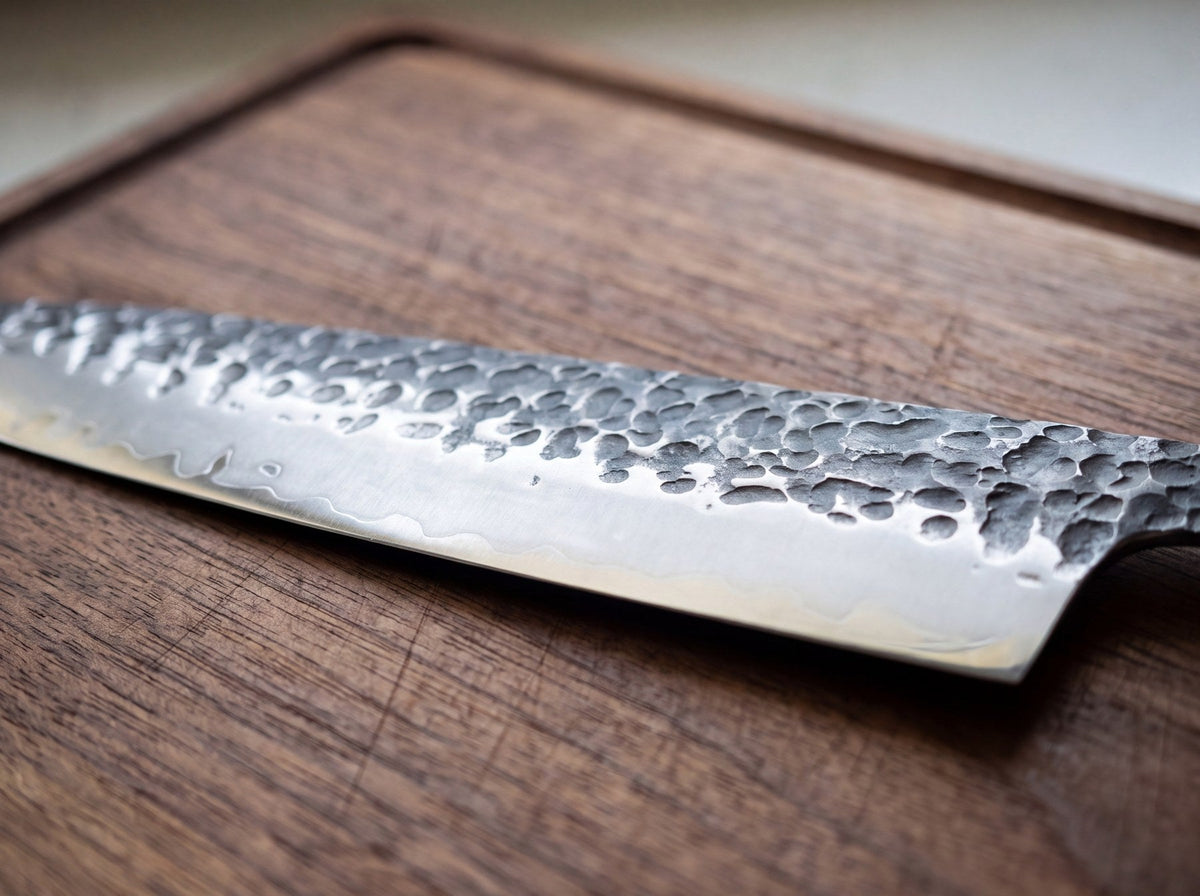
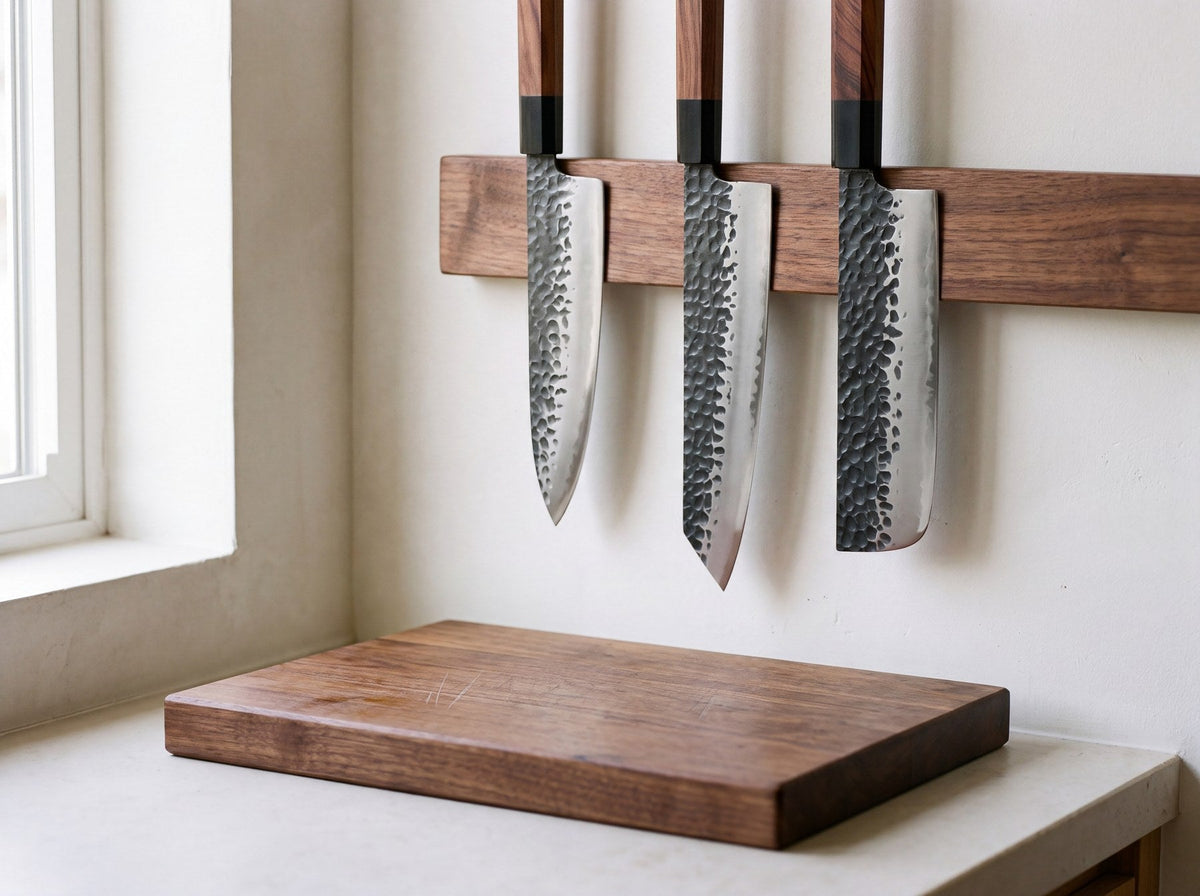
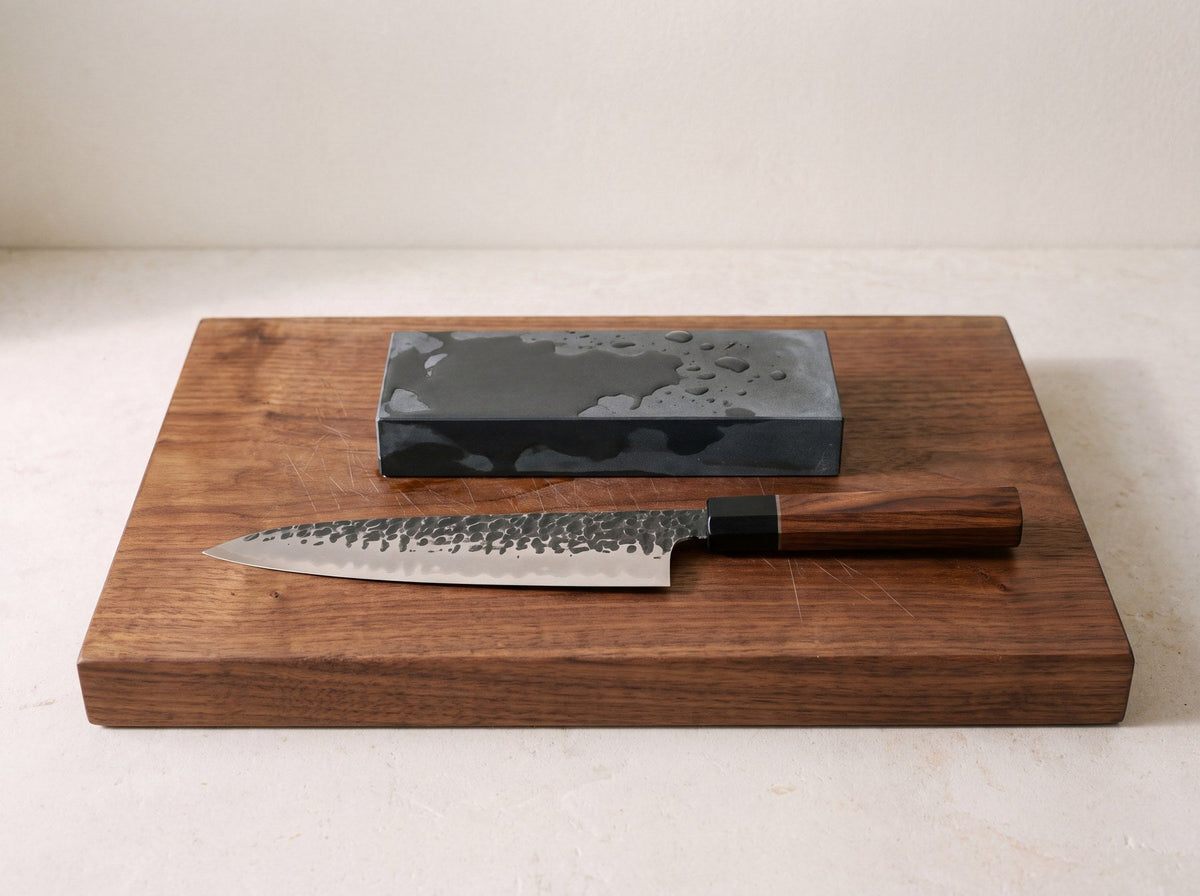
A gyuto chef knife is a Japanese all-purpose chef’s knife designed for cutting, slicing, chopping, and general food preparation. It typically has a pointed tip, curved cutting edge, and double-bevel blade, while its steel, geometry, weight, and dimensions can vary considerably between makers and models.
What Is a Gyuto Chef Knife?
A Gyuto is Japan’s take on the all-purpose chef knife. The name Gyuto (牛刀) is commonly translated as “beef sword,” reflecting the knife’s historical association with cutting meat, but modern Gyuto knives are designed for much more than meat preparation. They can handle everyday work such as slicing vegetables, chopping herbs, preparing boneless meat, portioning fish, and making precise cuts.
Unlike a knife defined by one particular steel or construction method, Gyuto describes a general knife category and blade style. A Gyuto may be made from stainless, carbon, or powder metallurgy steel and can differ significantly in thickness, grind, balance, blade height, and edge geometry.
Gyuto Chef Knife at a Glance
| Feature | Typical Gyuto Characteristics |
|---|---|
| Purpose | All-purpose kitchen preparation |
| Blade style | Pointed tip with a curved cutting edge |
| Edge | Usually double-bevel |
| Common sizes | 180 mm, 210 mm, 240 mm, 270 mm |
| Typical uses | Vegetables, herbs, boneless meat, fish and slicing |
| Construction | Varies by steel, maker and model |
This combination of versatility and a relatively precise cutting profile is what makes the Gyuto a practical choice as a primary kitchen knife. However, not every Gyuto feels or performs the same way. Blade length, steel, grind, edge angle, weight, and handle design all influence how a particular knife behaves on the cutting board.
What Is a Gyuto Knife Used For?
A Gyuto knife is used for everyday kitchen preparation, including slicing vegetables, chopping herbs, cutting boneless meat, preparing fish, and making precise cuts. Its pointed tip and curved edge give it enough versatility for both broad cutting tasks and more controlled work near the tip.
For vegetables, a Gyuto can handle everything from onions and carrots to leafy greens and herbs. Its length also gives you a useful cutting surface when working through larger ingredients. When preparing boneless meat or poultry, the relatively fine edge can make clean slicing and portioning easier.
The pointed tip is particularly useful when the job calls for more control. You can use it for trimming, separating smaller portions, or making precise cuts where the middle of the blade would be less convenient.
What Can You Use a Gyuto For?
| Good for | Avoid |
|---|---|
| Chopping vegetables | Cutting through bones |
| Slicing vegetables | Frozen foods |
| Chopping herbs | Hard prying or twisting |
| Preparing boneless meat | Using the blade as a cleaver |
| Slicing poultry | Excessive lateral pressure |
| Preparing fish fillets | Tasks requiring a specialized knife |
| Precision cuts | Rough misuse that can damage the edge |
A Gyuto is versatile, but versatility does not mean it should replace every knife in the kitchen. A dedicated vegetable knife, boning knife, cleaver, or other specialized blade may be better suited to tasks involving bones, very hard ingredients, or a particular cutting technique.
The important distinction is that Gyuto knives are general-purpose preparation knives, not heavy-duty blades. Their performance comes from using the blade for the type of cutting it was designed to do rather than forcing it through ingredients or tasks that can damage the edge.

What Makes a Gyuto Different From Other Chef Knives?
A Gyuto and a Western chef’s knife serve much the same broad purpose: both are designed to be versatile, everyday kitchen knives. The difference is in how individual knives are shaped, constructed, balanced, and sharpened. A Gyuto may feel lighter, thinner, or more precise than some Western chef’s knives, but those characteristics depend on the specific model rather than applying to every Japanese knife.
How Does a Gyuto Compare With a Western Chef's Knife?
The main difference is usually found in the blade geometry, weight, profile, and steel, rather than the basic job the knife performs. Many Western chef’s knives use a relatively substantial blade and are designed around a combination of chopping and rocking motions. Gyuto knives can have thinner geometries and harder steels, although plenty of variation exists between individual models.
| Feature | Gyuto | Western Chef's Knife |
|---|---|---|
| Primary role | General kitchen preparation | General kitchen preparation |
| Blade profile | Often more pointed with a curved edge | Often broader with a pronounced curve |
| Weight | Can be relatively light, depending on model | Often more substantial |
| Steel | Wide range of Japanese steels | Wide range of stainless and other steels |
| Edge geometry | Often relatively fine | Often somewhat more robust |
| Cutting feel | Can favor precise, low-resistance cuts | Often suited to a broader range of cutting techniques |
| Maintenance | Depends on steel and hardness | Depends on steel and construction |
It is worth avoiding a simple “Japanese versus Western” comparison. A thick, heavy Gyuto can behave very differently from a thin, lightweight Gyuto, just as Western chef’s knives vary considerably between manufacturers.
How Does a Gyuto Compare With a Santoku?
A Japanese Gyuto knife generally offers more blade length and a more pronounced pointed tip than a santoku. That extra reach can be useful when preparing larger ingredients or making longer slicing cuts.
Santoku knives are typically shorter and more compact, with a flatter cutting profile. They can feel particularly comfortable when working on a smaller cutting board or when most of your preparation involves shorter chopping and slicing motions.
| Feature | Gyuto | Santoku |
|---|---|---|
| Typical profile | Longer, more curved | Shorter, generally flatter |
| Tip | Pronounced pointed tip | More compact tip |
| Reach | Greater | More limited |
| Board space | Benefits from more room | Comfortable on smaller boards |
| General role | All-purpose chef knife | All-purpose kitchen knife |
| Precision work | Strong tip control | Good general-purpose control |
Neither profile automatically makes a better kitchen knife. The more useful question is which combination of length, profile, geometry, and handling fits the way you prepare food.
For cooks who want one longer knife with more reach and a pointed tip, Gyuto knives can be a natural fit. For those who prefer a compact blade and a shorter, flatter cutting profile, a santoku may make more sense.
What Gyuto Size Should You Choose?
The right Gyuto chef knife size depends mainly on your available workspace, the ingredients you prepare, and how much blade you are comfortable controlling. Blade length matters, but it should not be considered on its own. Blade height, weight, balance, handle design, and overall geometry can make two Gyuto of the same length feel completely different.
For many cooks, 210 mm provides a useful balance between reach and maneuverability. However, there is no universal “correct” size. A smaller kitchen or compact cutting board may favor a 180 mm Gyuto, while cooks who regularly prepare larger ingredients may prefer the additional reach of a 240 mm or longer blade.
Gyuto Size Chart
| Gyuto Size | Approx. Length | Typical Use | Workspace |
|---|---|---|---|
| 180 mm | 7 in | Compact everyday prep | Smaller cutting boards and kitchens |
| 210 mm | 8.25 in | General-purpose preparation | Versatile for most home setups |
| 240 mm | 9.5 in | Larger ingredients and longer slicing | Requires more board space |
| 270 mm | 10.6 in | High-volume or professional preparation | Best with a large workspace |
Is a 180 mm Gyuto Right for You?
A 180 mm Gyuto can be useful when counter space is limited or when you prefer a more compact knife. It is easier to maneuver around a smaller cutting board and can feel less cumbersome during shorter preparation tasks.
Is a 210 mm Gyuto a Good General-Purpose Size?
A 210 mm Japanese Gyuto knife offers a practical middle ground between maneuverability and reach. It provides enough blade length for most everyday preparation without demanding the workspace of a much longer knife.
That makes 210 mm a common reference point when comparing Gyuto sizes, but it should not automatically be treated as the best choice for every cook.
When Does a 240 mm Gyuto Make Sense?
A 240 mm Gyuto provides additional cutting length for larger ingredients and longer slicing movements. It can be particularly useful for cooks who have enough board space and are comfortable handling a longer blade.
The trade-off is simple: more blade requires more workspace and deliberate control.
Who Needs a 270 mm Gyuto?
A 270 mm Gyuto is a much longer option and is more suited to cooks who regularly work with larger ingredients or higher volumes of preparation. It needs a sufficiently large cutting board and workspace to be used comfortably.
Before choosing a longer Gyuto, check the usable length of your cutting board. The knife should have enough room to move without repeatedly hitting the edges of the board or surrounding equipment.
What Steel Is Used in Gyuto Knives?
The steel used in a Gyuto knife affects its edge retention, sharpening response, corrosion resistance, toughness, and overall maintenance. There is no single “Gyuto steel,” because different makers use stainless, carbon, and powder metallurgy steels depending on the knife’s intended performance.
| Steel category | Main characteristic | Maintenance |
|---|---|---|
| Stainless | Better corrosion resistance and easier everyday care | Lower |
| Carbon | Easy sharpening and responsive cutting feel | Higher |
| Powder metallurgy | High wear resistance and strong edge retention | Model-dependent |
Stainless steel is often a practical choice for home cooks who want less maintenance. It is more resistant to staining and corrosion, making it easier to use regularly without worrying about immediate drying after every cut.
Carbon steel is valued by many knife enthusiasts for its sharpening response and cutting feel. However, it requires more attention because exposure to moisture or acidic ingredients can lead to discoloration or corrosion.
Powder metallurgy steels are engineered for high wear resistance and can offer excellent edge retention. Their sharpening characteristics and maintenance requirements depend on the specific steel and heat treatment rather than the category alone.
Hardness is another specification worth understanding. Gyuto knives may have relatively high HRC ratings, but a higher hardness number does not automatically make one knife better than another. Heat treatment, blade geometry, edge thickness, grind, and intended use all influence how a knife performs.
For example, applicable HARUTANI Gyuto models use a VG-10 core, 60 ±2 HRC hardness and 67-layer Damascus construction. These specifications describe the construction and material characteristics of those particular models rather than defining every Gyuto knife.

What Should You Know About Gyuto Blade Geometry?
Blade geometry has a major influence on how a Gyuto feels on the cutting board. Two knives can use similar steel yet cut very differently because of differences in spine thickness, grind, edge thickness, blade height, profile and edge angle.
A thinner blade generally moves through food with less resistance, while a thicker, more substantial geometry can provide additional robustness for heavier everyday prep. This is why choosing a Gyuto based only on its steel type or HRC rating can miss an important part of the knife’s actual cutting behavior.
You may also come across terms such as “laser” and “workhorse” when comparing Gyuto knives. These are informal knife-community descriptions rather than standardized manufacturing categories. A laser generally refers to a very thin, lightweight geometry designed for low cutting resistance, while a workhorse usually describes a thicker, more substantial knife built around durability and a stronger cutting feel.
Edge angle is another specification worth checking. Many Gyuto are sharpened somewhere around 15–18° per side, while individual makers may use different angles. HARUTANI product information, for example, states that applicable knives are hand-honed around 12–15°, depending on the product. There is therefore no single edge angle that defines a Gyuto.
Ultimately, geometry should be considered together with steel, heat treatment, blade length, profile and intended cutting technique rather than treated as an isolated specification.
How Should You Choose a Japanese Gyuto Knife?
Choosing a Japanese Gyuto knife is easier when you look beyond the steel name or Damascus pattern. The right choice depends on how you prepare food, how much workspace you have, and how you prefer a knife to feel in your hand.
A practical way to compare Gyuto knives is to consider these factors in order:
- Blade length: Choose a size that fits your cutting board and typical ingredients. A shorter blade can feel easier to control, while a longer blade provides more reach for larger ingredients and longer slicing motions.
- Cutting style: Consider whether you mostly chop, push-cut, slice or use a combination of techniques. Blade profile and geometry can affect how naturally a knife suits your preferred motion.
- Steel and maintenance: Stainless steel can simplify everyday care, while carbon and certain high-performance steels may require more attention.
- Grind and geometry: Compare thickness, edge geometry and overall blade construction rather than assuming every Gyuto cuts the same way.
- Weight and balance: Some cooks prefer a lightweight, agile knife, while others want more blade presence and stability.
- Handle design: Handle shape, material and balance can influence comfort during longer preparation sessions.
- Ingredients: Think about what you actually cut. A Gyuto is well suited to vegetables, herbs, boneless meat and other general preparation, but specialized knives may be preferable for tasks involving bones or particularly hard foods.
Which Gyuto suits different cooks?
| User | What to consider |
|---|---|
| Home cook | Manageable size, easy maintenance and versatile geometry |
| Professional chef | Blade length, edge retention, balance and repeated-use comfort |
| Culinary enthusiast | Steel, grind, profile and sharpening characteristics |
| Collector | Craftsmanship, construction, finish, materials and individual maker details |
The key is to compare the complete knife specification, not just its appearance or steel designation. A beautiful Damascus finish may attract attention, but blade geometry, balance, dimensions and maintenance requirements have a much greater effect on everyday use.
How Should You Care for a Gyuto Chef Knife?
Proper care helps a Gyuto chef knife maintain its edge, finish and cutting performance over time. Most Japanese kitchen knives benefit from simple habits: hand wash, dry immediately and use the knife only on an appropriate cutting surface.
Do
- Hand wash the knife with mild dish soap and water.
- Dry it immediately after washing, especially when using carbon or high-hardness steel.
- Use a suitable cutting board, such as wood or soft plastic.
- Store the knife safely in a block, saya or other protective storage.
- Sharpen it appropriately when the edge begins to lose its bite.
Avoid
- Dishwashers, which can expose the blade to heat, moisture and harsh detergents.
- Glass, stone or ceramic cutting surfaces, which can damage the edge.
- Cutting through bones or frozen foods unless the particular knife is specifically designed for that task.
- Prying, twisting or lateral force, particularly with thin-edged blades.
A harder, thinner Gyuto can deliver excellent cutting performance, but it also rewards more deliberate handling. Regular cleaning, proper storage and appropriate sharpening are usually more important to long-term knife care than complicated maintenance routines.

Which Gyuto Knives Are Available From HARUTANI?
HARUTANI offers a dedicated Gyuto collection for cooks looking to compare Japanese chef knives across different constructions, blade lengths, finishes and handle designs. Rather than choosing a knife based only on its appearance, compare the specifications that match your cooking style and maintenance preferences.
The HARUTANI Gyuto collection allows you to explore details such as:
- Blade length for different workspace and preparation needs
- Steel construction and core material
- Damascus layering and finish
- Handle design and overall balance
- Weight and blade specifications
- Edge geometry where product-specific information is provided
Individual models can differ considerably, so the specifications listed on each product page should be used when comparing knives. For example, applicable HARUTANI models feature a VG-10 core, 60 ±2 HRC hardness and 67-layer Damascus construction.
If you already know the blade length and type of cutting experience you prefer, the collection makes it easier to narrow your options without treating one Gyuto specification as universally suitable.
Explore the [HARUTANI Gyuto collection] to compare the available models and their individual specifications.
Frequently Asked Questions About Gyuto Chef Knives
What is a gyuto chef knife?
A Gyuto chef knife is a Japanese all-purpose kitchen knife designed for tasks such as chopping, slicing and general food preparation. It typically has a pointed tip, curved cutting edge and double-bevel design, although exact geometry varies between makers and models.
What size Gyuto should I buy?
For many home kitchens, 180 mm, 210 mm and 240 mm are practical sizes to consider. A 180 mm Gyuto suits smaller workspaces, while 210 mm offers a versatile balance for everyday preparation. A 240 mm blade provides more reach for larger ingredients and longer slicing tasks.
Is a Gyuto the same as a chef's knife?
A Gyuto and a Western chef's knife serve a similar all-purpose role, but they can differ in blade geometry, weight, profile, steel, hardness and edge characteristics. A Gyuto should therefore be considered a Japanese chef-knife category rather than simply an identical version of a Western chef's knife.
Can you use a Gyuto for meat and vegetables?
Yes. A Gyuto is well suited to vegetables, herbs, boneless meat, poultry and fish fillets, along with general slicing and chopping. Bones, frozen foods and hard materials are generally better handled with knives specifically designed for those tasks.
What is the difference between a Gyuto and a santoku?
A Gyuto is generally longer and has a more pronounced pointed tip and curved profile, giving it greater reach and versatility for slicing and different cutting motions. A santoku is usually shorter and more compact, with a flatter profile that suits cooks who prefer a controlled, compact cutting style. Exact shapes vary by manufacturer.